Fact-checked and updated October 2026.
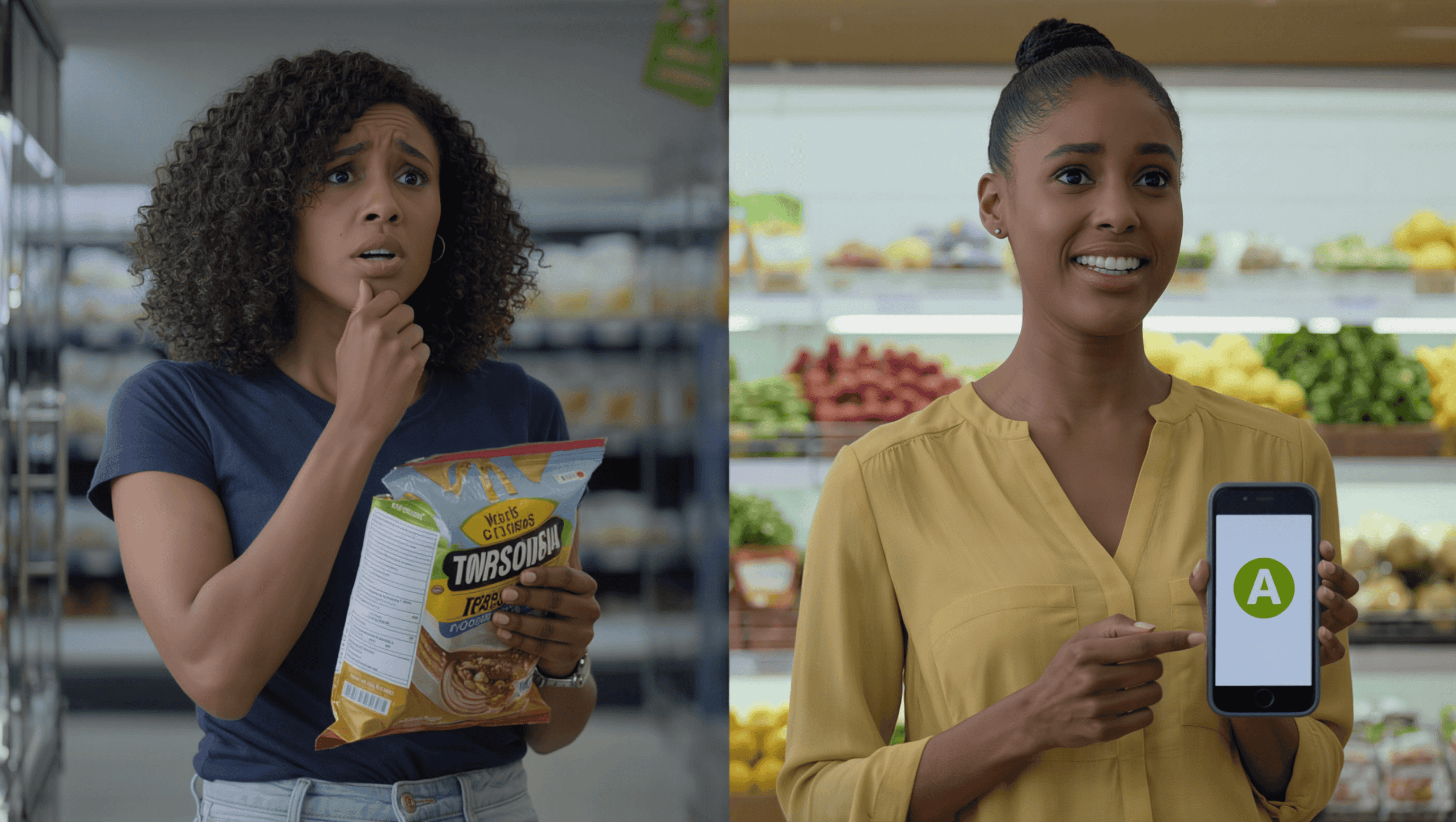
Have you ever stood in a grocery store aisle, reading an ingredient list, and realized you have no idea what half those words mean? You’re not alone. Most people trust that the products on store shelves are safe because they passed government inspections. They believe labels tell the truth.
We believed that too. Until we learned otherwise.
Two different journeys. Two separate awakenings. One shared conclusion: The food industry has been lying to us, and nobody was doing anything about it.
That’s why we built NutraDetective.
Our Awakening Stories
DeJuan’s Discovery
Everything changed for me after watching a food documentary in 2009. What I saw shattered every assumption I had about our food system.
Factory farms that looked nothing like the happy pictures on packaging. Farmers being destroyed by corporations. Animals being fed diets their bodies couldn’t process, leading to bacteria growing inside them. And all of that meat was going to grocery stores across America.
I couldn’t unsee it. Every meal became a question mark.
That documentary launched a 10-year journey of research, label reading, and discovering just how deep the deception goes. I switched from conventional to organic. Then from meat-eating to vegetarian. Eventually to fully plant-based eating.
But the deeper I went, the more I realized something: most people don’t have 10 years to figure this out. Families are feeding their kids foods they think are healthy while the ingredient lists tell a very different story.
Ahnjonee’s Journey
My awakening came through my own body in 2013.
I developed mysterious food sensitivities seemingly overnight. Foods I’d eaten my whole life suddenly made me sick. Doctors ran allergy tests. Every single one came back negative.
I was eating foods that made me physically ill, and medical tests were telling me I had no allergies. I started questioning my own sanity.
So I did what I do best: research. Hours of reading studies, talking to people, cross-referencing information. That’s when I discovered the truth about what was really in my food.
If this happened to me—someone who grew up shopping at health food stores, someone who bought organic—it could happen to anyone. You or someone you love might be struggling with unexplained sensitivities right now, searching for answers that medical tests can’t provide.
My journey continues, but identifying the culprit and receiving targeted nutritional support brought me relief I didn’t think was possible. Today we share what we’ve learned on the NutraDetective blog, so you can start solving your own food mysteries.
But before we built the app, we had to face a frustrating reality.
The Problem: Current Food Apps Fall Short
Food scanner apps exist. You might have heard of Yuka, which scores food products out of 100 (Yuka, n.d.). It launched in France in 2017, and in October 2025 the United States became its number one market (Yuka, 2026). Some apps focus mainly on counting calories. We wanted one that also flags harmful additives and synthetic ingredients.
This matters because research shows ultra-processed food consumption is associated with increased risk of cardiovascular disease, cerebrovascular disease, depression, and all-cause mortality (Pagliai et al., 2021). Learn why these foods can be so easy to overeat in Food Addiction: The Tobacco Playbook.
We couldn’t find one that brought together what matters most to us: ingredient safety, sourcing transparency, and whether products align with values that honor creation.
We wanted more than a number. We wanted a simple letter grade, with clear warnings that show why a product scored the way it did.
And here’s what really frustrated us: We couldn’t find an app built around the additives and ingredients American shoppers actually see on US labels. US food regulations are drastically different from European standards. We allow ingredients that other countries have banned. We use different terminology, different additives, different labeling requirements.
American families needed an app built for the products they actually find on their grocery store shelves.
Introducing NutraDetective: Built Different
We built NutraDetective to solve these problems.
This isn’t just another calorie counter. This isn’t a confusing numerical score that leaves you wondering what it means. This is a comprehensive food scanner app designed specifically for ingredient analysis—with transparency at its core.
Here’s what makes NutraDetective different:
-
Instant Barcode Scanning – Scan any product and get instant results—no typing, no searching.
-
Simple A-F Nutrition Score – Clear letter grades you understand instantly, with A meaning excellent and F meaning avoid.
-
Complete Ingredient Analysis – Our comprehensive database identifies harmful additives, hidden ingredients like natural flavors, and potential health concerns.
-
ADHD-Linked Additive Alerts – Scans point out additives that research has linked to hyperactivity in children, such as certain artificial food colors and the preservative sodium benzoate (McCann et al., 2007).
-
Personalized Allergen Warnings – Set your allergen profile once, and every scan alerts you to ingredients you need to avoid.
-
US-Specific Focus – Built specifically for American consumers with FDA-approved additives, GRAS ingredients, and US brands you actually find in stores.
Shoppers want this kind of transparency. In Label Insight’s 2016 survey of more than 2,000 consumers, nearly 9 in 10 said transparency is important to them across every food product category, 94% said they are likely to be loyal to a brand that offers complete transparency, and 73% said they would pay more for a product that offers complete transparency in all attributes (Label Insight, 2016). NutraDetective delivers exactly that.
The Foundation: 7 Pillars of Eden
Our app isn’t just about nutrition numbers. We’re working on a comprehensive framework called the 7 Pillars of Eden—biblical principles for evaluating food that go far beyond calories and macros.
These ancient guidelines address seven core principles:
-
Seed Purity – Food as God designed, without genetic modification
-
Creature Care – Humane treatment of animals
-
Earth Honor – Sustainable farming, minimal pesticide use
-
Worker Justice – Fair wages and safe working conditions
-
Plant Wisdom – Whole foods over ultra-processed products with transparent ingredients, not vague terms like “natural flavors”
-
Community Share – Supporting local, accessible food systems
-
Gratitude Practice – Transparency and mindful eating
These principles guide how we are developing NutraDetective’s scoring.
Right now, our Nutrition Score is fully functional—grading products on nutritional content and ingredient safety.
The complete Eden Score is in development and will expand this to evaluate all 7 Pillars individually, including creature care, worker justice, and environmental impact. We’ll share updates on the blog as this work moves forward.
How the App and Blog Work Together
NutraDetective is your practical, daily tool. You scan. You get instant answers. You make informed decisions right there in the grocery store.
But the app gives you scores without necessarily explaining the deeper “why” behind them. That’s where our blog comes in. It explains the research behind the warnings you see when you scan.
Our articles walk you through what studies have found on topics like food preservatives and GMOs, and each one lists its sources so you can check them yourself.
Together, they create complete food transparency:
-
The app = What to buy right now
-
The blog = Why it matters and how to change
You can use the app on its own. But when you understand the principles behind the scores, you’ll know WHY certain foods score higher—and your choices become informed, not just reactive.
For example, our article on food additives and ADHD explains what studies have found about synthetic food dyes and children’s behavior, and the app alerts you to ADHD-linked additives when you scan.
Start Your Food Transparency Journey Today
Download NutraDetective right now. It’s available for both iOS and Android. The basic features are free. Scan your entire pantry tonight and see what you discover. You’ll probably be shocked. We were.
Then keep learning on our blog. Our guides to the Dirty Dozen and the Clean Fifteen can help your family decide when organic produce is worth the money.
Join the community. Families like yours are choosing transparency over deception—people who refuse to let the food industry make decisions about their health, parents who want their kids to grow up knowing what real food tastes like. Share your journey on social media, and keep learning with us on our blog. You’re not alone in this.
References
Label Insight. (2016). 2016 Transparency ROI Study. As reported in Supermarket News: Label Insight study finds consumers would pay more for products that offer complete transparency. https://supermarketnews.com/consumer-trends/label-insight-study-finds-consumers-would-pay-more-for-products-that-offer-complete-transparency
McCann, D., Barrett, A., Cooper, A., Crumpler, D., Dalen, L., Grimshaw, K., Kitchin, E., Lok, K., Porteous, L., Prince, E., Sonuga-Barke, E., Warner, J. O., & Stevenson, J. (2007). Food additives and hyperactive behaviour in 3-year-old and 8/9-year-old children in the community: A randomised, double-blinded, placebo-controlled trial. The Lancet, 370(9598), 1560-1567. https://doi.org/10.1016/S0140-6736(07)61306-3
Pagliai, G., Dinu, M., Madarena, M. P., Bonaccio, M., Iacoviello, L., & Sofi, F. (2021). Consumption of ultra-processed foods and health status: A systematic review and meta-analysis. British Journal of Nutrition, 125(3), 308-318. https://doi.org/10.1017/S0007114520002688
Yuka. (n.d.). How are food products scored? Yuka Help Center. https://help.yuka.io/l/en/article/ijzgfvi1jq-how-are-food-products-scored
Yuka. (2026). Yuka press kit (United States). https://yuka.io/wp-content/uploads/presskit/us/yuka-presskit.pdf