Fact-checked October 2026.
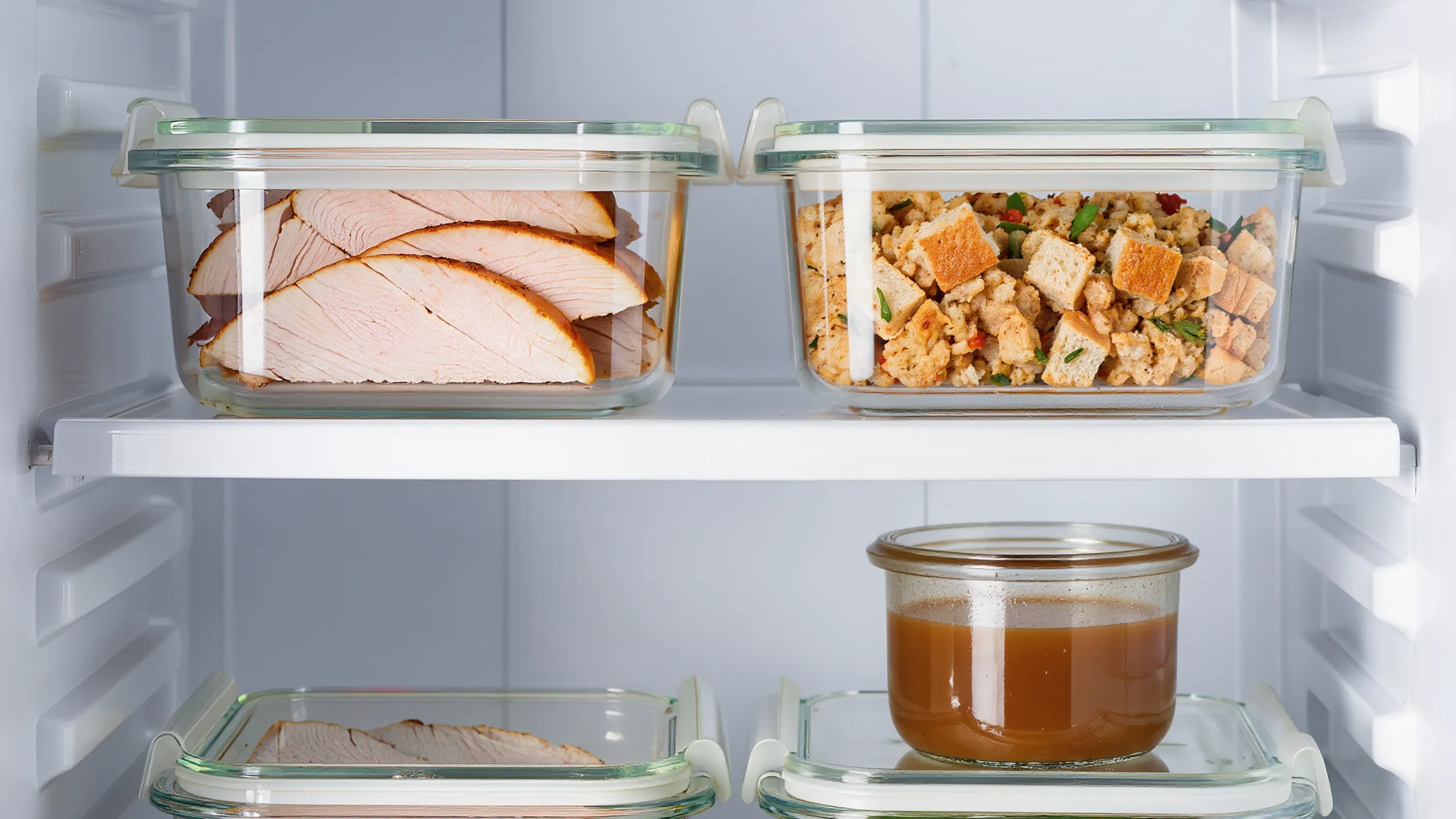
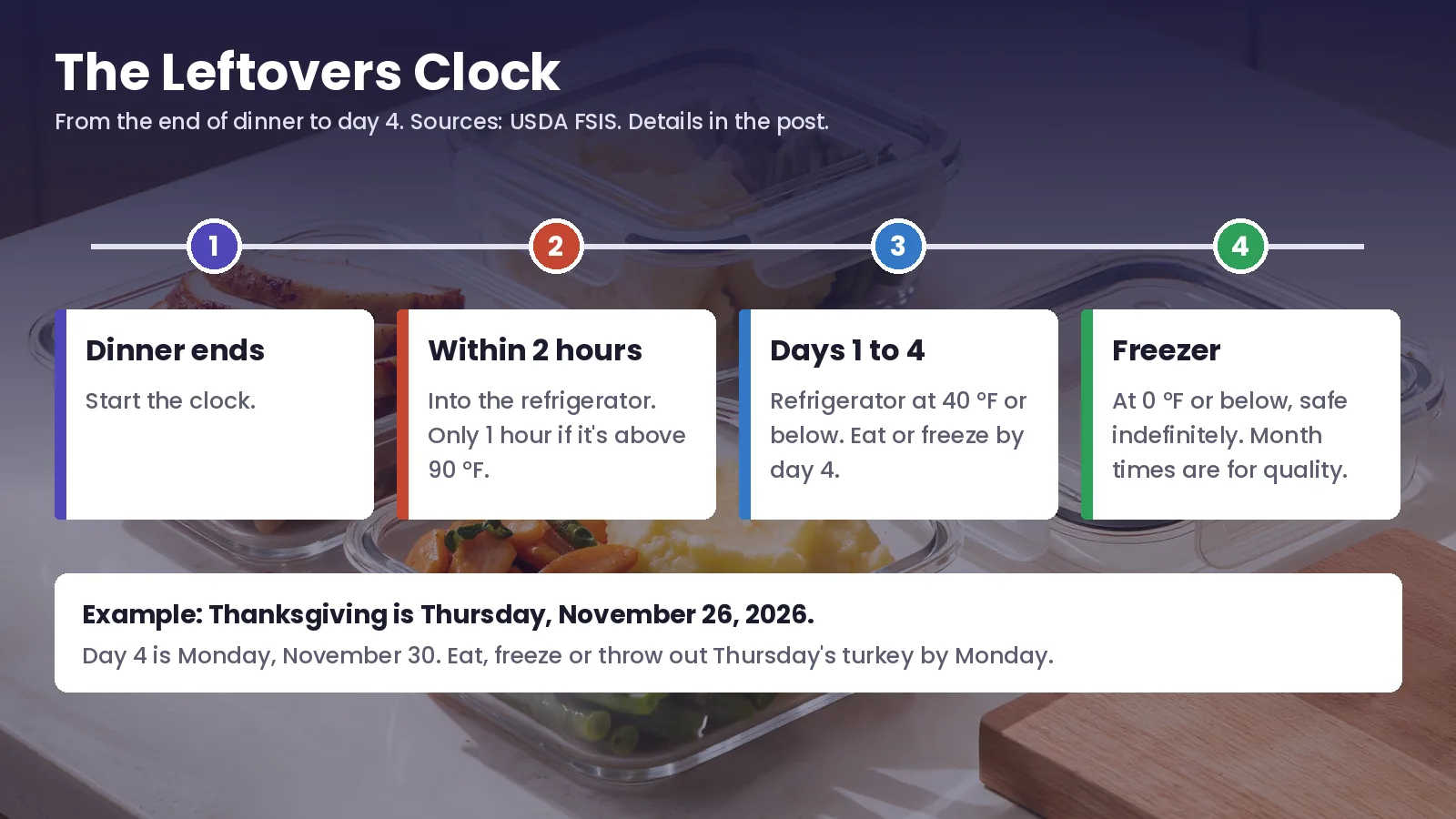
Thanksgiving leftovers are safe for 3 to 4 days in the refrigerator. That's USDA's number for cooked turkey, cooked dishes and gravy [2]. But the clock starts sooner than that. Leftovers need to be in the refrigerator within 2 hours of cooking [1].
So how long are Thanksgiving leftovers safe? It depends on where you are on the clock. This post follows it from the moment dinner ends: the first 2 hours, packing up, 4 days in the refrigerator, the freezer, thawing and reheating. No labels this time. Just the USDA, CDC and FoodSafety.gov rules, in order.
How Long Can Thanksgiving Leftovers Sit Out?
Two hours. USDA says to refrigerate leftovers within 2 hours of cooking, or of taking food out of a warming appliance [1]. Perishable food that sits out longer than that gets thrown away. The limit drops to 1 hour when it's above 90 °F [1]. USDA's turkey page says the same thing: don't leave perishable food out for more than 2 hours [2].
Here's what that looks like. If dinner is served at 3:00 pm, the leftovers go into the refrigerator by 5:00 pm [1, 2]. That's an example, not a rule. The rule is the 2 hours.
Why 2 hours? USDA calls 40 °F to 140 °F the Danger Zone. That's where bacteria can grow faster [3]. In the Danger Zone, bacteria can double in number in as little as 20 minutes [3]. So USDA says never to leave food between 40 °F and 140 °F for more than 2 hours. Above 90 °F, it's 1 hour [3]. While food is out, keep hot food at 140 °F or warmer and cold food at 40 °F or below [1].
How Should You Pack Up Thanksgiving Leftovers?
Small and shallow. USDA says to divide large amounts of food into shallow containers so they cool fast. Cut large items, like the turkey, into smaller pieces [1]. Slice the breast. The legs and wings can stay whole [2]. Potatoes, gravy and vegetables go into shallow containers too [2].
You don't have to wait for the food to cool. Hot food can go straight into the refrigerator. Or you can cool it first in an ice or cold water bath [1].
Two more things. If the meal won't be eaten right away, take all the stuffing out of the turkey cavity right away and refrigerate it [2]. And if you're freezing, wrap the turkey and trimmings tightly. It's safe to freeze them, even if the turkey was bought frozen [2]. USDA says cooking stuffing outside the bird is the safest choice to begin with [6]. We covered that in our stuffing mix post.
How Many Days Do Thanksgiving Leftovers Last in the Refrigerator?
Three to four days, at 40 °F or below [1, 2]. That's USDA's time for cooked turkey, and for cooked dishes and gravy [2]. FoodSafety.gov's cold storage chart agrees: leftovers of cooked meat or poultry keep 3 to 4 days [5].
Count it out. Thanksgiving 2026 is Thursday, November 26. Friday is day 1, Saturday is day 2, Sunday is day 3, and Monday, November 30 is day 4 [2]. Turkey cooked on Thursday should be eaten, frozen or thrown out by Monday.
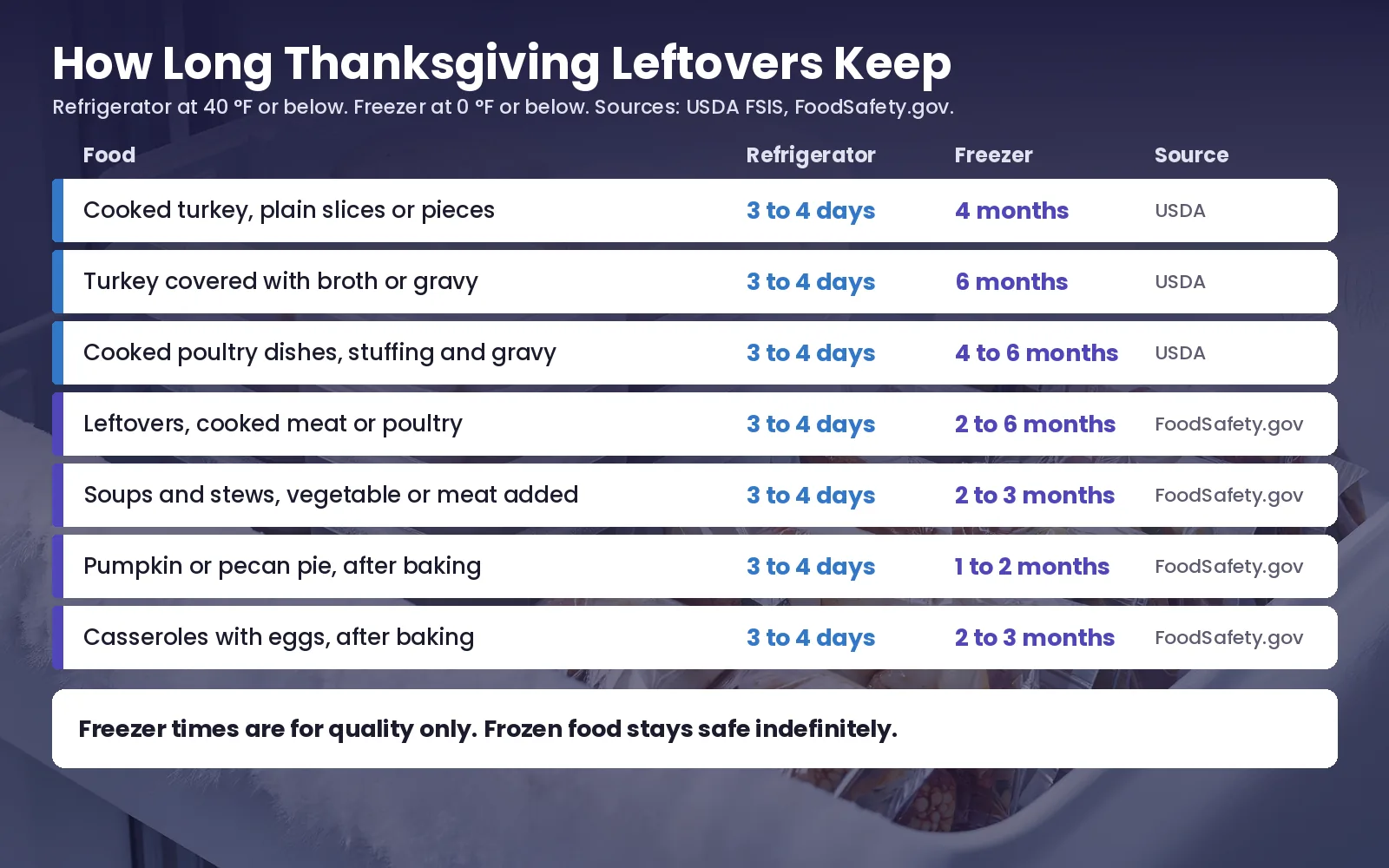
Here's the chart, food by food. The refrigerator column is at 40 °F or below, and the freezer column is at 0 °F or below [2, 5].
| Food | Refrigerator | Freezer | Source |
|---|---|---|---|
| Cooked turkey, plain slices or pieces | 3 to 4 days | 4 months | USDA [2] |
| Turkey covered with broth or gravy | 3 to 4 days | 6 months | USDA [2] |
| Cooked poultry dishes, stuffing and gravy | 3 to 4 days | 4 to 6 months | USDA [2] |
| Leftovers, cooked meat or poultry | 3 to 4 days | 2 to 6 months | FoodSafety.gov [5] |
| Soups and stews, vegetable or meat added | 3 to 4 days | 2 to 3 months | FoodSafety.gov [5] |
| Pumpkin or pecan pie, after baking | 3 to 4 days | 1 to 2 months | FoodSafety.gov [5] |
| Casseroles with eggs, after baking | 3 to 4 days | 2 to 3 months | FoodSafety.gov [5] |
What about mashed potatoes or the vegetables? The FoodSafety.gov chart has no row for stuffing, gravy, cooked vegetables or mashed potatoes [5]. So use USDA's "cooked dishes and gravy" line for them: 3 to 4 days [2].
We've also read the labels on two of the side dishes: canned cranberry sauce and gravy mix.
How Long Do Thanksgiving Leftovers Last in the Freezer?
For safety, there's no limit, as long as it stays frozen at 0 °F or below. USDA says "Freezer storage times are for quality only." Frozen food stays safe indefinitely [2]. Its leftovers page says the same: frozen leftovers are safe indefinitely, but they can lose quality [1].
The month numbers are about quality. USDA's turkey page gives 4 months for plain turkey slices or pieces. It gives 6 months for turkey covered with broth or gravy. Cooked poultry dishes, stuffing and gravy get 4 to 6 months [2]. Its leftovers page says 3 to 4 months for leftovers in general [1]. FoodSafety.gov says 2 to 6 months for cooked meat or poultry [5]. The pages don't match, and that's fine. They're all quality numbers, not safety numbers [1, 2, 5].
How Do You Thaw Frozen Leftovers?
Three ways to thaw, plus a fourth option: skip thawing [1].
- In the refrigerator. This takes the longest, but the leftovers stay safe the whole time. After thawing this way, use them within 3 to 4 days, or refreeze [1].
- In cold water. Put the food in a leak-proof bag. Food thawed this way has to be cooked before it can be refrozen [1].
- In the microwave. Heat it to 165 °F right after thawing [1].
- Don't thaw at all. It's safe to reheat frozen leftovers without thawing them first. It just takes longer [1].
For frozen cooked turkey, USDA says to thaw it on a tray in the refrigerator. Allow about 1 day for every 4 to 5 pounds. Once it's thawed, eat it within 3 to 4 days [2].
Can you refreeze? Yes, after the food has been reheated to 165 °F [1]. And if you thawed a container in the refrigerator and only used part of it, the rest can go back in the freezer without reheating [1].
What Temperature Should You Reheat Thanksgiving Leftovers To?
165 °F. USDA says to reheat all leftovers to 165 °F [1], or until steaming hot [2]. Gravy, sauces and soups get brought to a rolling boil [1, 2]. That's the same 165 °F USDA gives for cooking poultry in the first place [1].
Don't reheat a whole turkey. Cut the meat into smaller pieces first [2].
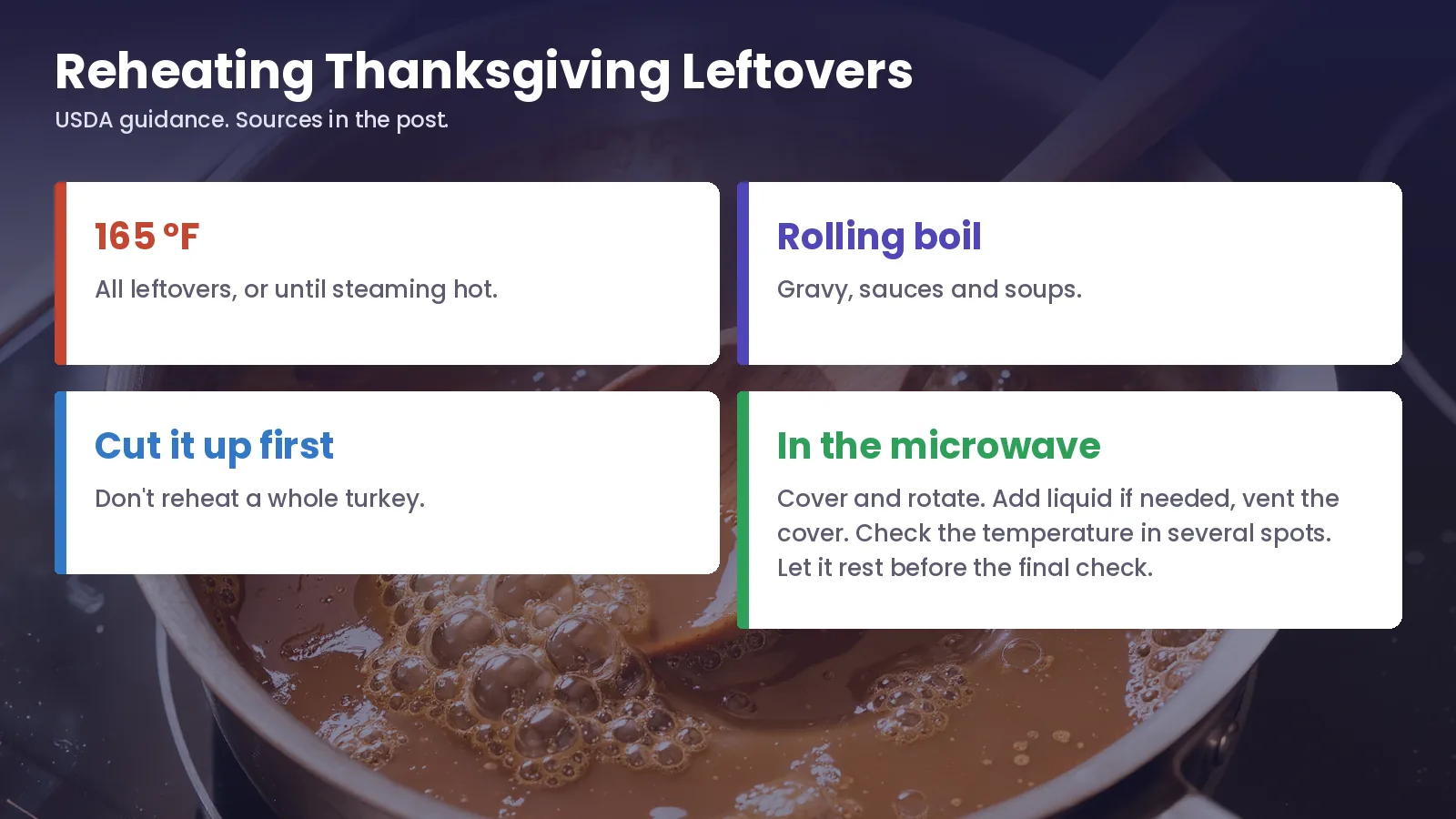
In the microwave, USDA gives these steps. Cover the food and rotate it. Add liquid if needed, and vent the cover. Check the temperature in several spots. Let it rest before the final check [1].
Here's why the temperatures matter. CDC estimates nearly 900,000 foodborne illnesses from a germ called C. perfringens in the U.S. each year [4]. Its common food sources are poultry, such as turkey and chicken; meat, such as beef and pork; and gravy [4]. Outbreaks most often involve food cooked in large batches and held between 40 °F and 140 °F [4]. CDC says most outbreaks happen in November and December, often in places that serve large groups, and many are linked to holiday foods like turkey and roast beef [4]. The symptoms are diarrhea and stomach cramps [4]. That's why the clock matters: 2 hours, 4 days, 165 °F.
So here's your leftovers clock for this year. Dinner ends; leftovers are in the refrigerator within 2 hours. Thursday's turkey is eaten, frozen or thrown out by Monday. Anything reheated hits 165 °F, and gravy comes to a boil. And on the next grocery run, check what's in the box before it comes home.
Frequently Asked Questions
A. USDA says 3 to 4 days at 40 °F or below. That covers cooked turkey, cooked dishes and gravy. FoodSafety.gov gives the same 3 to 4 days for leftovers of cooked meat or poultry.
A. Two hours. USDA says to refrigerate leftovers within 2 hours of cooking. If it's above 90 °F, the limit is 1 hour. Perishable food that sits out longer should be thrown away.
A. USDA's refrigerator time for cooked turkey, cooked dishes and gravy is 3 to 4 days. Past day 4, it's outside USDA's guidance. Freeze leftovers before then if you won't finish them.
A. It stays safe indefinitely. USDA says freezer storage times are for quality only. For quality, USDA gives 4 months for plain turkey slices or pieces, 6 months for turkey covered with broth or gravy, and 4 to 6 months for cooked poultry dishes, stuffing and gravy.
A. In the refrigerator, on a tray, for about 1 day per 4 to 5 pounds. Once it's thawed, eat it within 3 to 4 days. Other leftovers can also thaw in cold water in a leak-proof bag, in the microwave, or be reheated straight from frozen.
A. 165 °F, or until steaming hot. Bring gravy, sauces and soups to a rolling boil. Don't reheat a whole turkey; cut it into smaller pieces first.
A. Yes, after they've been reheated to 165 °F. If you thawed a container in the refrigerator and used part of it, the rest can be refrozen without reheating. Food thawed in cold water has to be cooked before refreezing.
References
- USDA Food Safety and Inspection Service. Leftovers and Food Safety. Last updated July 31, 2020. https://www.fsis.usda.gov/food-safety/safe-food-handling-and-preparation/food-safety-basics/leftovers-and-food-safety
- USDA Food Safety and Inspection Service. Turkey Basics: Handling Cooked Dinners. Last updated September 25, 2024. https://www.fsis.usda.gov/food-safety/safe-food-handling-and-preparation/poultry/turkey-basics-handling-cooked-dinners
- USDA Food Safety and Inspection Service. USDA Urges Consumers to Keep Clear of the "Danger Zone" This Summer. Press release, May 26, 2016. https://www.fsis.usda.gov/news-events/news-press-releases/usda-urges-consumers-keep-clear-danger-zone-summer
- Centers for Disease Control and Prevention. About C. perfringens Food Poisoning. Last updated September 28, 2026. https://www.cdc.gov/clostridium-perfringens/about/index.html
- FoodSafety.gov (U.S. Department of Health and Human Services). Cold Food Storage Charts. Last reviewed September 19, 2023. https://www.foodsafety.gov/food-safety-charts/cold-food-storage-charts
- USDA Food Safety and Inspection Service. Turkey Basics: Stuffing. Last updated August 8, 2024. https://www.fsis.usda.gov/food-safety/safe-food-handling-and-preparation/poultry/turkey-basics-stuffing