
Fact-checked October 2026.
Stove Top Chicken lists 24 ingredients and Pepperidge Farm lists 15 [1, 2, 5]. Sodium runs from 260 mg to 410 mg per labeled serving, and the serving sizes aren't the same [3, 1, 2, 5]. That's the short version of what four stuffing mix ingredient lists show.
We compared four mixes. Two are Stove Top: Stove Top Stuffing Mix For Chicken and Stove Top Stuffing Mix For Chicken Lower Sodium. The third is Kroger Chicken Flavored Stuffing Mix. The fourth is Pepperidge Farm Herb Seasoned Stuffing Classic. We read each label as listed by a grocery store, then checked the federal rules for the sodium claims and the additives. Here's the table, then one section on each thing it compares.
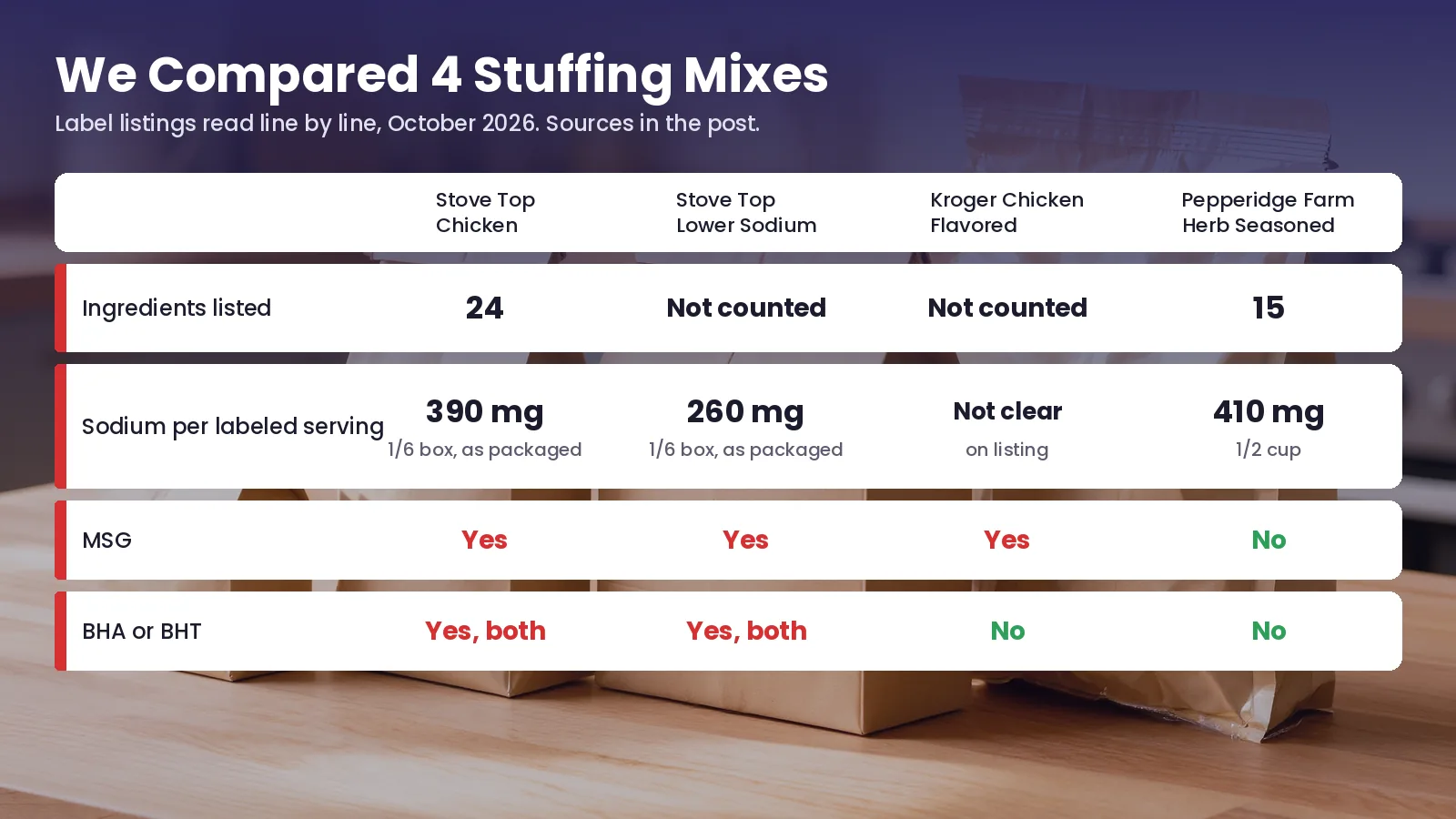
| Stove Top Chicken, 6 oz box | Stove Top Lower Sodium, 6 oz box | Kroger Chicken Flavored, 6 oz | Pepperidge Farm Herb Seasoned, 12 oz bag | |
|---|---|---|---|---|
| Ingredients listed | 24 [1, 2] | Not counted (the listing repeats part of the list) | Not counted (full list not available) | 15 [5] |
| Sodium per labeled serving | 390 mg, 1/6 box, as packaged [1, 2] | 260 mg, 1/6 box, as packaged [3] | Not clear on listing | 410 mg, 1/2 cup [5] |
| MSG | Yes [1, 2] | Yes [3] | Yes [4] | No [5] |
| BHA or BHT | Yes, both [1, 2] | Yes, both [3] | No [4] | No [5] |
How Much Sodium Is in Stuffing Mix?
Start with the regular Stove Top box. The serving is 1/6 of the box, and the box holds 6 servings [1, 2]. The Nutrition Facts panel is for the dry mix, before you add anything [1, 2]. One serving has 390 mg of sodium, which is 17% of the Daily Value [1, 2]. It also has 110 calories, 1 g of fat, 21 g of carbohydrate, 2 g of added sugar and 3 g of protein [1, 2].
Add it up. Six servings at 390 mg comes to about 2,340 mg of sodium in the whole box, dry [1]. The Daily Value for sodium is less than 2,300 mg a day [16]. So one dry box holds a little more than a full day's worth.
Say it's the Thanksgiving grocery run. Two Stove Top boxes go into the same cart, the regular one and the Lower Sodium one. The Lower Sodium box has 260 mg per serving as packaged, or 11% of the Daily Value [3]. That's 130 mg less sodium per serving as packaged, about 33% less. The box itself claims 25% less [3]. Calories are the same, 110, and protein is 4 g [3].
What do those words on the box mean? Under FDA rules, "reduced sodium," "less sodium" and "lower sodium" all mean the same thing. The food has at least 25% less sodium than a comparable food [12]. "Low sodium" is a different claim. It means 140 mg or less per standard serving set by FDA. FDA calls that the reference amount customarily consumed. It's not the labeled serving. Foods with a reference amount of 30 g or less must also have 140 mg or less per 50 g [12]. Lower Sodium Stove Top doesn't meet "low sodium" either way. One serving is about 28 g, and 260 mg per 28 g works out to about 464 mg per 50 g [3, 12].
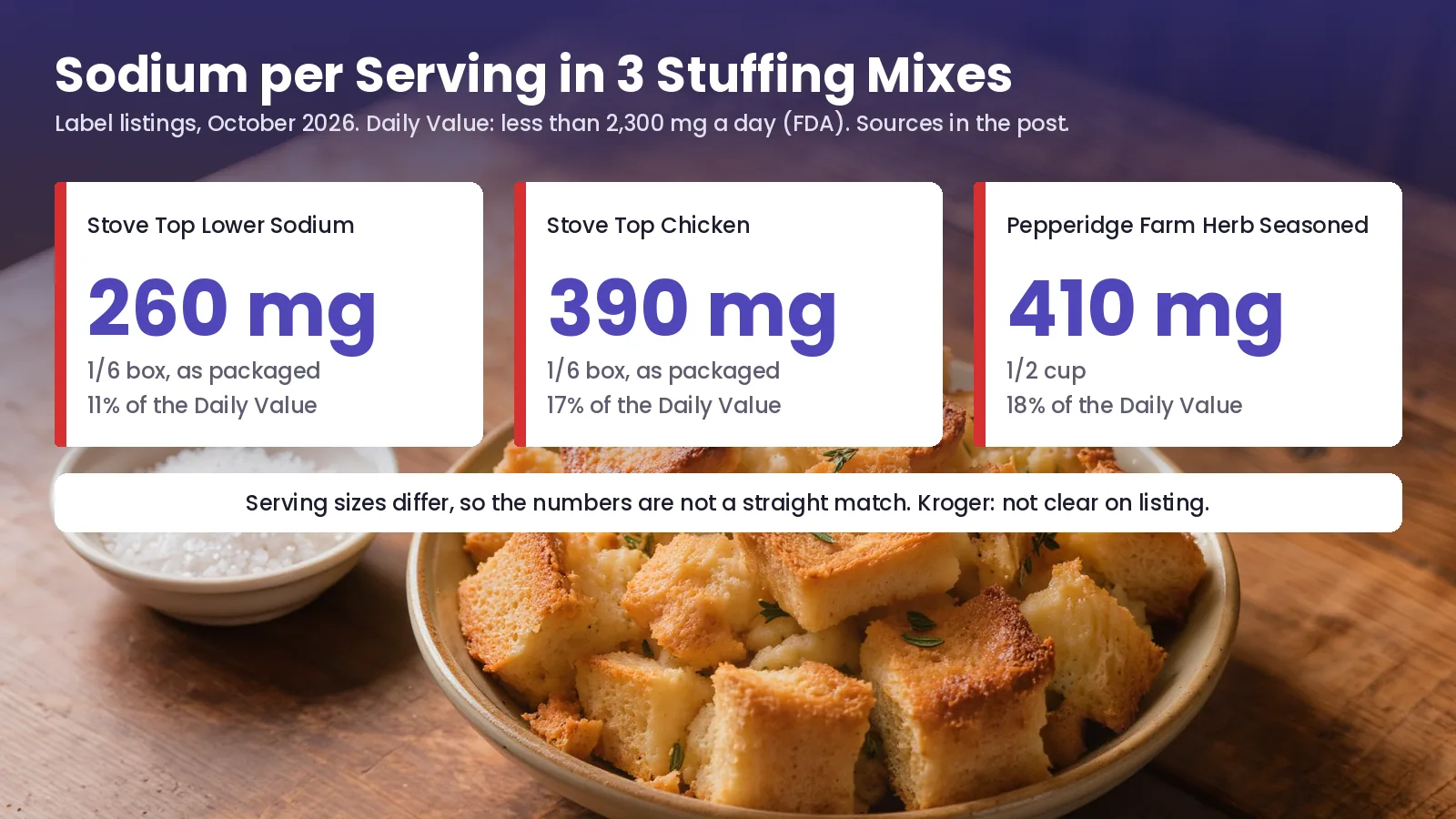
Now the Pepperidge Farm bag. Its serving is 1/2 cup, with 110 calories and 410 mg of sodium, or 18% of the Daily Value [5]. The bag holds 12 servings [5]. Its serving isn't the same size as Stove Top's 1/6 box, so the numbers aren't a straight match. We left Kroger out of this part. Its listing doesn't say whether the numbers are for the dry mix or the prepared dish.
For scale, the FDA says Americans eat about 3,400 mg of sodium a day on average [16]. Most of it, over 70%, comes from packaged and prepared foods [16]. The FDA's guide says 5% of the Daily Value or less per serving is low, and 20% or more is high [16]. Stove Top's 17% sits just under that high line [16]. We read another side dish the same way in our look at canned cranberry sauce.
Which Stuffing Mixes Have MSG and Other Flavor Enhancers?
Three of the four list MSG. On the Stove Top Chicken label, the first three ingredients are enriched wheat flour, high fructose corn syrup and onion. Then comes the line "Contains Less Than 2% Of," and the rest of the list follows it [1, 2]. In that part are monosodium glutamate, hydrolyzed soy protein, disodium guanylate and disodium inosinate [1, 2]. Monosodium glutamate is MSG. Hydrolyzed soy protein is soy protein broken down into smaller parts.
The Lower Sodium box lists the same group: monosodium glutamate, hydrolyzed soy protein, disodium guanylate and disodium inosinate [3]. The Kroger mix lists monosodium glutamate, caramel color, hydrolyzed soy protein and hydrolyzed corn protein. It also lists oleoresin turmeric, a color [4]. Pepperidge Farm lists no MSG [5].
What are the two disodium ingredients for? Federal rules allow disodium guanylate as a flavor enhancer, at a level no higher than needed for the effect [9]. Disodium inosinate is listed as a flavoring adjuvant, which means a helper for flavor [10]. We looked at MSG itself in our MSG post.
Take a potluck sign-up sheet. Someone writes "no MSG please" next to the stuffing. With these four, that means the Pepperidge Farm bag.
Which Stuffing Mixes Have BHA and BHT?
Two of the four. The Stove Top Chicken label says "With BHA, BHT And Rosemary Extract As Preservatives" [1, 2]. The Lower Sodium box lists the same three [3]. The Kroger mix lists no BHA, BHT or TBHQ [4]. Pepperidge Farm lists no BHA or BHT [5].
Pepperidge Farm uses other ingredients for that job. It lists calcium propionate to extend freshness, and rosemary extract and ascorbic acid to protect flavor [5]. Federal rules list calcium propionate as GRAS for use as an antimicrobial agent [11]. GRAS means "generally recognized as safe." An antimicrobial slows the growth of mold and germs. In baked goods, it can be used at levels within current good manufacturing practice, with no other limit [11]. That means using only as much as the job needs.
What does BHA do? The FDA says it's used to prevent fats and oils from spoiling [13]. Federal rules list BHA as GRAS when the total antioxidants are not over 0.02 percent of the food's fat or oil content [6]. BHT has the same rule [7]. There's a second rule for a few specific foods. It sets a limit of 50 parts per million in dry breakfast cereals and in potato flakes [8]. Stuffing mix isn't on that list, so the 0.02 percent rule is the one that covers it.
The rest of the Stove Top list includes maltodextrin, potassium chloride and interesterified soybean oil. It also lists turmeric as a color and silicon dioxide as an anticaking agent [1, 2]. An anticaking agent keeps a powder from clumping. The Stove Top Chicken label says "Contains: wheat, soy" [1, 2]. For more on how preservatives differ, see our guide to food preservatives.
Is BHA Under Review? What FDA and HHS Said in 2025 and 2026
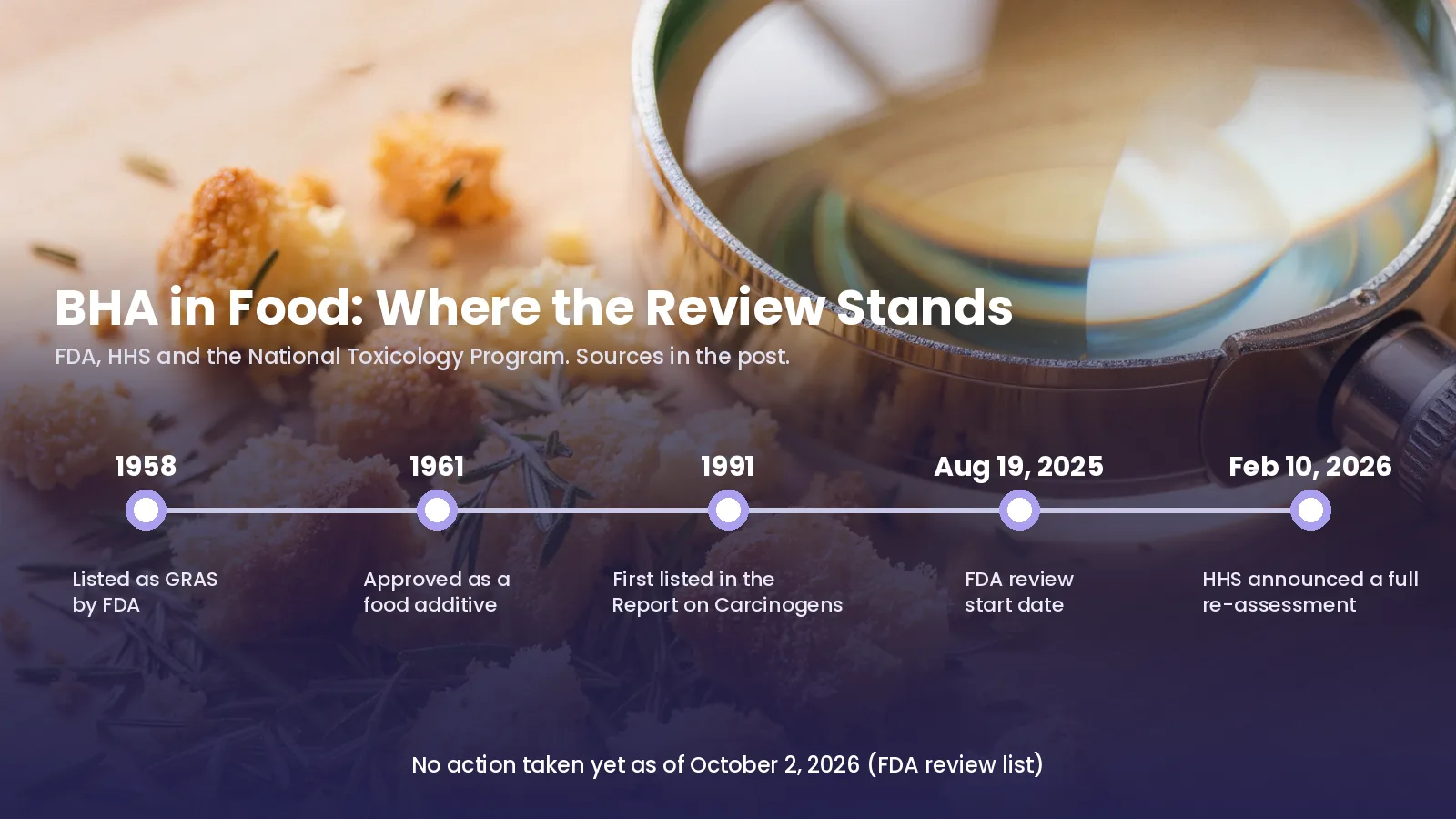
Yes. FDA put BHA on its list of food chemicals under review, with a review start date of August 19, 2025 [14]. Then, on February 10, 2026, HHS made an announcement. FDA had launched a full re-assessment of whether BHA is safe under its current uses in food [13]. The two dates aren't a conflict. The first is when the review opened on FDA's list. The second is when the full re-assessment was announced.
Here's what the announcement said. The use of BHA in packaged foods has gone down in recent years, but it's still in many products [13]. FDA issued a request for information on the use and safety of BHA [13]. The docket number is FDA-2026-N-0302 [13, 14]. Once the BHA assessment is done, FDA expects to do the same for BHT and azodicarbonamide [13]. BHT is already on the review list too. Its review started August 19, 2025, and its current step is "Review of Information" [14]. Its docket is FDA-2026-N-2526 [14]. For both, the list shows no risk management action yet [14].
Why review it? The National Toxicology Program puts out the Report on Carcinogens. A carcinogen is something that can cause cancer. The report lists BHA as "reasonably anticipated to be a human carcinogen" [15]. BHA was first listed in the sixth report, in 1991 [15]. The listing is based on sufficient evidence from studies in animals [15]. In those studies, BHA in the diet caused benign and malignant tumors of the forestomach. That was in rats of both sexes and in male mice and hamsters [15].
What about people? The same report says the human studies aren't good enough to judge the link between cancer and BHA on its own [15]. It cites one study of stomach cancer, done inside the Netherlands Cohort Study. That study found no increase in risk at typical levels of BHA in the diet [15]. So the animal evidence is there, the human evidence isn't settled, and the FDA review is open. We cover BHA alongside other additives in our food additives guide.
How to Cook Stuffing Safely
Now to the oven on Thanksgiving morning. The USDA says to cook stuffing separately from the turkey. That's the safest way, and it cooks evenly [17]. If you stuff the bird anyway, use a food thermometer. The center of the stuffing must reach 165 °F [17].
A few more USDA rules. Don't mix the wet and dry ingredients until just before you spoon the stuffing into the turkey [17]. Stuff it loosely, about 3/4 cup of stuffing per pound of turkey [17]. And never stuff a turkey that will be grilled, smoked, fried or microwaved [17].

Before you buy, flip the package. Check the sodium line and the serving size, since the serving sizes differ from one mix to the next. Then read past "Contains Less Than 2% Of" for MSG and the preservative line. To check any mix in the aisle, scan it with the free app.
Frequently Asked Questions
A. Stove Top Stuffing Mix For Chicken lists 24 ingredients. The first three are enriched wheat flour, high fructose corn syrup and onion. After "Contains Less Than 2% Of" come salt, monosodium glutamate, hydrolyzed soy protein, disodium guanylate, disodium inosinate and others, with BHA, BHT and rosemary extract as preservatives.
A. It depends on the mix and the serving. Stove Top Chicken has 390 mg per 1/6 box as packaged. Stove Top Lower Sodium has 260 mg per 1/6 box as packaged. Pepperidge Farm Herb Seasoned has 410 mg per 1/2 cup. The Daily Value is less than 2,300 mg a day.
A. No. Under FDA rules, "low sodium" means 140 mg or less per standard serving set by FDA. Lower Sodium Stove Top has 260 mg per serving as packaged. It does meet the "lower sodium" claim, which means at least 25% less than a comparable food.
A. Three of the four we compared list monosodium glutamate: Stove Top Chicken, Stove Top Lower Sodium and Kroger Chicken Flavored. Pepperidge Farm Herb Seasoned lists no MSG.
A. BHA is a preservative. The FDA says it's used to keep fats and oils from spoiling. Both Stove Top mixes list BHA, BHT and rosemary extract as preservatives. Federal rules list BHA as GRAS when the total antioxidants are not over 0.02 percent of the food's fat or oil content.
A. Not as of this writing. FDA put BHA on its review list with a start date of August 19, 2025, and HHS announced a full re-assessment on February 10, 2026. FDA's list shows no risk management action yet. The National Toxicology Program lists BHA as reasonably anticipated to be a human carcinogen, based on animal studies, while it says the human studies are inadequate to judge.
A. The USDA says cooking stuffing separately is the safest choice. If you stuff the turkey, the center of the stuffing must reach 165 °F on a food thermometer. Mix wet and dry ingredients just before stuffing, stuff loosely at about 3/4 cup per pound, and never stuff a turkey that will be grilled, smoked, fried or microwaved.
References
- Hannaford. Stove Top Stuffing Mix For Chicken, 6 oz box (product listing). https://hannaford.com/groceries/rice-pasta-beans/packaged-meals-sides/stove-top-stuffing-mix-for-chicken-6-oz-box.html
- Giant Food Stores. Stove Top Stuffing Mix For Chicken, 6 oz box (product listing). https://giantfoodstores.com/groceries/product/stove-top-stuffing-mix-for-chicken-6-oz-box/6017
- Food Lion. Stove Top Stuffing Mix For Chicken Lower Sodium, 6 oz box (product listing). https://foodlion.com/groceries/product/stove-top-stuffing-mix-for-chicken-lower-sodium-6-oz-box/30013
- King Soopers. Kroger Chicken Flavored Stuffing Mix, 6 oz (product listing). https://www.kingsoopers.com/p/kroger-chicken-flavored-stuffing-mix/0001111089291
- Hannaford. Pepperidge Farm Herb Seasoned Stuffing Classic, 12 oz bag (product listing). https://hannaford.com/groceries/rice-pasta-beans/pepperidge-farm-herb-seasoned-stuffing-classic-12-oz-bag.html
- Code of Federal Regulations. 21 CFR 182.3169, Butylated hydroxyanisole. Current as of October 2026. https://www.ecfr.gov/current/title-21/chapter-I/subchapter-B/part-182/subpart-D/section-182.3169
- Code of Federal Regulations. 21 CFR 182.3173, Butylated hydroxytoluene. Current as of October 2026. https://www.ecfr.gov/current/title-21/chapter-I/subchapter-B/part-182/subpart-D/section-182.3173
- Code of Federal Regulations. 21 CFR 172.110, BHA. Current as of October 2026. https://www.ecfr.gov/current/title-21/chapter-I/subchapter-B/part-172/subpart-B/section-172.110
- Code of Federal Regulations. 21 CFR 172.530, Disodium guanylate. Current as of October 2026. https://www.ecfr.gov/current/title-21/chapter-I/subchapter-B/part-172/subpart-H/section-172.530
- Code of Federal Regulations. 21 CFR 172.535, Disodium inosinate. Current as of October 2026. https://www.ecfr.gov/current/title-21/chapter-I/subchapter-B/part-172/subpart-H/section-172.535
- Code of Federal Regulations. 21 CFR 184.1221, Calcium propionate. Current as of October 2026. https://www.ecfr.gov/current/title-21/chapter-I/subchapter-B/part-184/subpart-B/section-184.1221
- Code of Federal Regulations. 21 CFR 101.61, Nutrient content claims for the sodium content of foods. Current as of October 2026. https://www.ecfr.gov/current/title-21/chapter-I/subchapter-B/part-101/subpart-D/section-101.61
- U.S. Department of Health and Human Services. FDA Launches Assessment of BHA, a Common Food Chemical Preservative. February 10, 2026. https://www.hhs.gov/press-room/fda-launches-assessment-bha-common-food-chemical-preservative.html
- U.S. Food and Drug Administration. List of Select Chemicals in the Food Supply Under FDA Review. Content current as of October 2, 2026. https://www.fda.gov/food/food-chemical-safety/list-select-chemicals-food-supply-under-fda-review
- National Toxicology Program. Report on Carcinogens, Fifteenth Edition: Butylated Hydroxyanisole. https://ntp.niehs.nih.gov/ntp/roc/content/profiles/butylatedhydroxyanisole.pdf
- U.S. Food and Drug Administration. Sodium in Your Diet. Content current as of March 5, 2024. https://www.fda.gov/food/nutrition-education-resources-materials/sodium-your-diet
- USDA Food Safety and Inspection Service. Turkey Basics: Stuffing. https://www.fsis.usda.gov/food-safety/safe-food-handling-and-preparation/poultry/turkey-basics-stuffing