
Fact-checked October 2026.
The FDA still allows Red 40 in U.S. food, and it says most children have no bad effects from color additives, though some may be sensitive. That's the short answer to "is Red 40 bad for you?" The FDA is also working with food makers to phase out six dyes, including Red 40. Its tracker now gives the end of 2027 as the target.
So Red 40 isn't banned. And the FDA says some children may be sensitive to it. Let's walk through the paper trail.
Here's what we checked. We read the federal rule that allows Red 40. We read the FDA's own pages on color additives, on how dyes are made, and on its phase-out plan. We read the safety reviews from EFSA, the European food safety agency, and from JECFA, the WHO expert committee. We read the 2007 Lancet trial, the 2012 review of ADHD studies, and the new West Virginia law. Here's what we found.
What Is Red 40 Made From?
Red 40 is a synthetic color additive. Synthetic means it's made in a factory, not taken from a plant. The FDA allows it in food, including dietary supplements, in amounts that fit good manufacturing practice [1]. That means the maker uses only as much as the job needs.
Where does it come from? Synthetic food dyes like Red 40 are made today mainly from raw materials that come from petroleum [3].
Red 40 has other names. The FDA's list of substances added to food gives "Allura Red AC" and "Allura Red" as other names for FD&C Red No. 40 [6]. Picture a bag of red fruit snacks. The back might say "Red 40." A U.S. label may also add "Allura Red" in parentheses. Same dye.
Red 40 is one of many color additives. Our overview of food additives shows where it fits.
Does Red 40 Cause Hyperactivity in Kids?
Some studies suggest a link in some children. No study on our list shows that Red 40 alone causes it. Here's what the research found, and what it didn't.
The biggest study is from 2007. It ran in The Lancet, a medical journal. It was a randomized, double-blinded, placebo-controlled trial. Randomized means chance decided who got what. Double-blinded means neither the kids nor the researchers knew who got what. Placebo-controlled means one drink had no additives, for comparison. The trial included 153 three-year-olds and 144 eight-to-nine-year-olds. The test drinks had sodium benzoate, a preservative, plus one of two artificial color mixes. Or they had a placebo [10].
The authors concluded that artificial colors or sodium benzoate, or both, increased hyperactivity in 3-year-old and 8/9-year-old children in the general population [10].
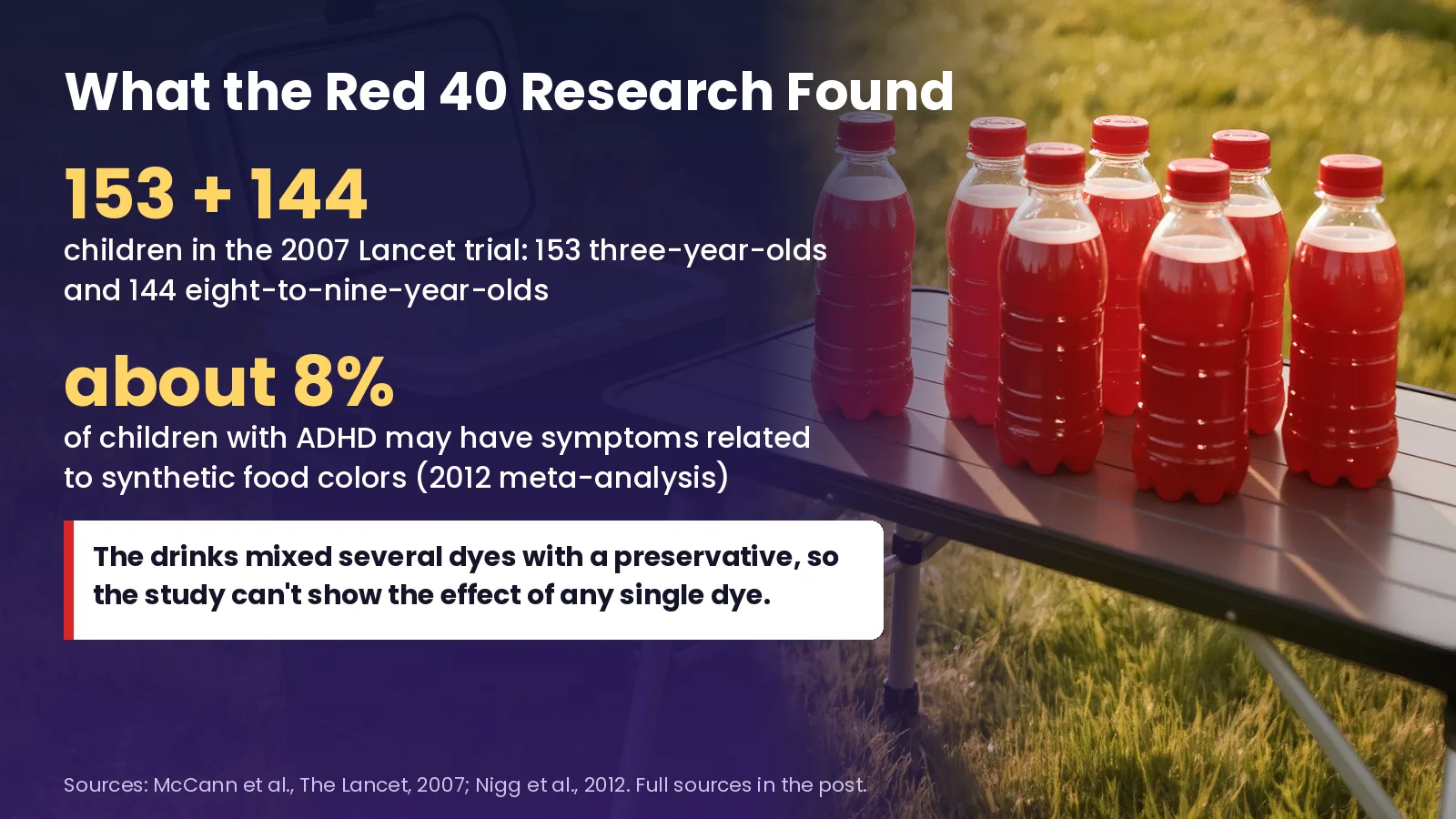
Here's the catch. The drinks mixed several dyes with a preservative. So the study can't show the effect of any single dye [10]. It can't tell you what Red 40 does on its own. Think of a red sports drink at a soccer game. The Lancet study can't say whether the red dye in it matters.
A 2012 review looked at many studies at once. That's called a meta-analysis. It estimated that about 8% of children with ADHD may have symptoms related to synthetic food colors. The authors added a caution. Some of the effects may reflect publication bias or small samples [12]. Publication bias means studies that find something get published more often than studies that find nothing. And there's one more limit. The effect was not reliable in studies limited to FDA-approved food colors [12]. Red 40 is an FDA-approved color.
So what couldn't we find? We found no study on our list that tests Red 40 by itself in children. We found no study that shows Red 40 causes ADHD. The research shows a possible link between mixed dyes and hyperactivity in some kids. That's as far as it goes. We dug into the same research in our post on food additives and ADHD.
Is Red 40 Safe? Where FDA, EFSA and JECFA Stand
Three groups have reviewed Red 40. Here's what each one says.
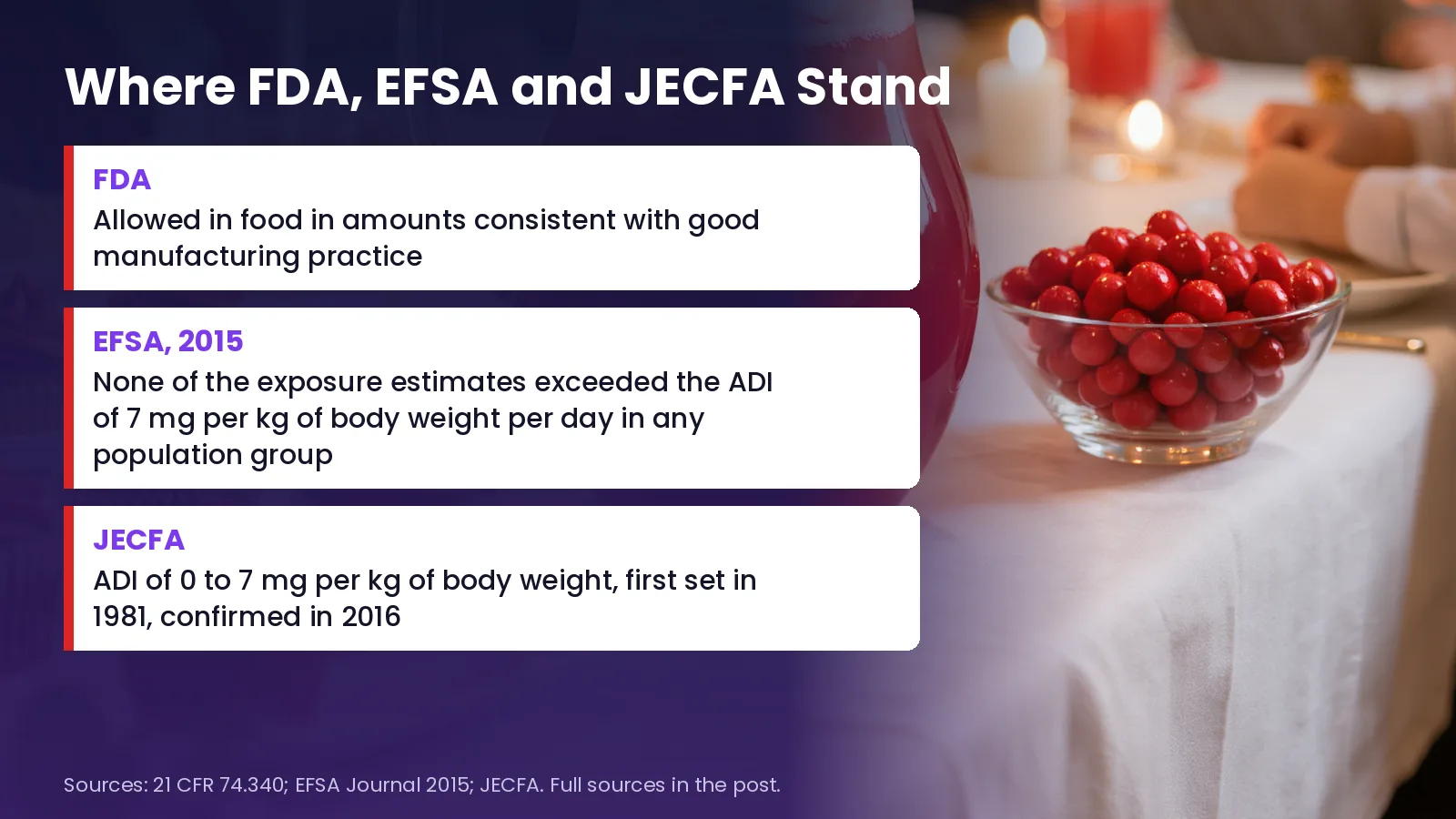
FDA. The FDA says most children have no adverse effects from color additives. It also says some evidence suggests certain children may be sensitive to them [2].
EFSA. EFSA is the European Food Safety Authority. In Europe, Red 40 is called Allura Red AC, or E 129. EFSA's 2009 review used an acceptable daily intake of 7 mg per kg of body weight per day. An acceptable daily intake, or ADI, is a safety limit for how much a person can take in each day. In 2009, EFSA found some young children could go above it [7]. Then EFSA looked again in 2015 with new data. This time, none of the exposure estimates exceeded that ADI in any population group [7].
JECFA. JECFA is the expert committee on food additives run by the WHO and FAO. Its ADI for Allura Red AC is 0 to 7 mg per kg of body weight. JECFA first set it in 1981 and confirmed it at its 82nd meeting in 2016. JECFA also found that children's exposure does not present a health concern [8].
What does 7 mg per kg mean at a birthday party? It means the limit depends on the child's weight. A smaller child reaches it with less dye.
Is Red 40 Being Banned in the US?
Not by law. The FDA phase-out is voluntary. Food companies have made voluntary commitments to drop it. Red 40 is still allowed in U.S. food [5, 1].
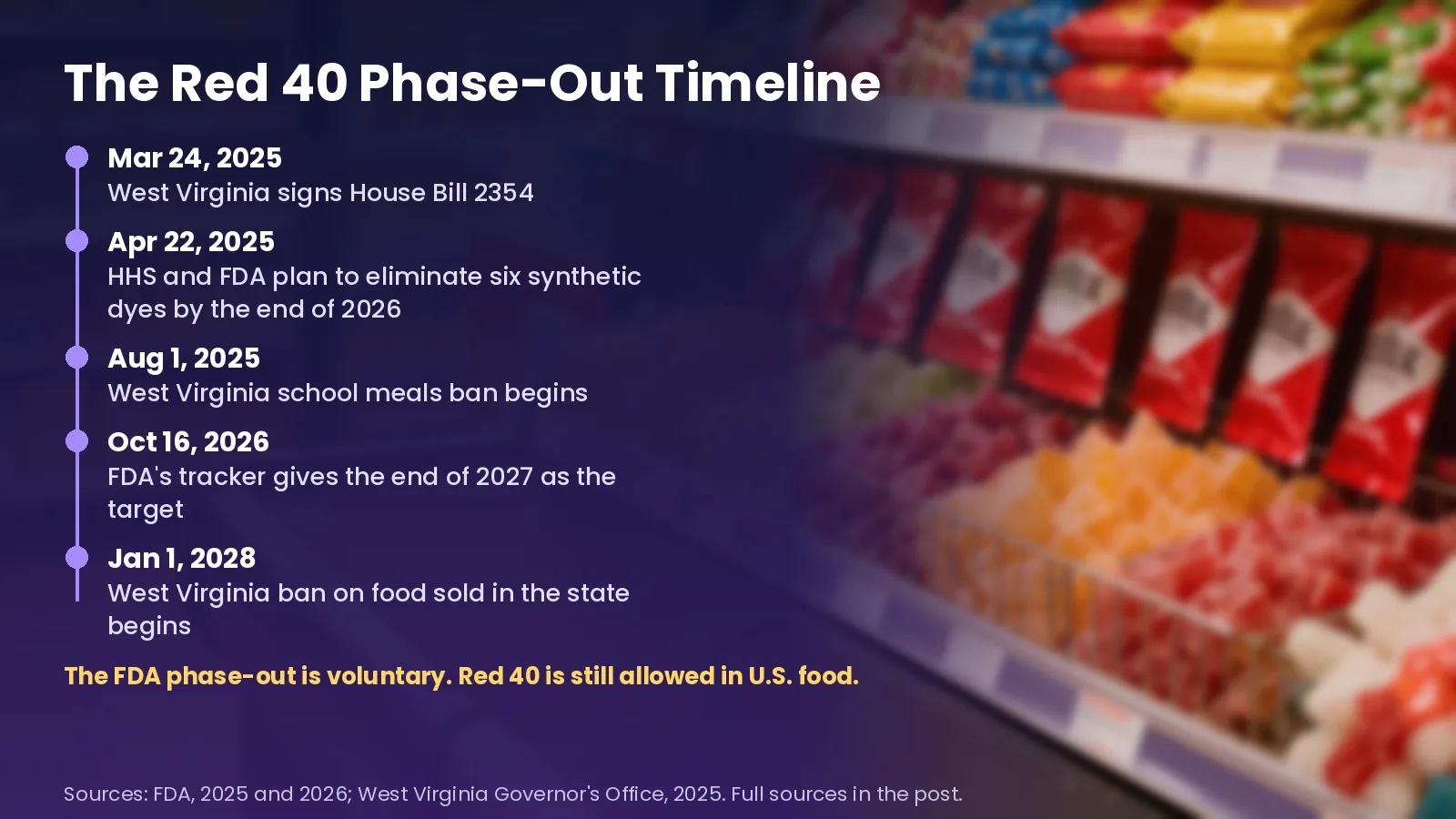
Here's the timeline. On April 22, 2025, HHS and the FDA announced a plan. They would work with industry to eliminate six remaining synthetic dyes, including Red 40, by the end of 2026 [4]. That date has moved. The FDA's pledge tracker is current as of October 16, 2026. It now gives the end of 2027 as the target for eliminating the six remaining certified color additives [5].
What does that mean at the checkout lane? The candy rack can still hold Red 40 today, and it can next year too. Some brands have pledged to change. Others haven't. The only way to know is to read the label. We did that for 16 Halloween candies in our Red 40 candy label check.
How to Spot Red 40 on a Label
You can find Red 40 on any U.S. label in a few seconds. The rules say it has to be there.
A certified color must be named on the label. It can use the full name, FD&C Red No. 40, or the short name, Red 40. A lake is a form of the dye that doesn't dissolve in water. It must include the word "Lake," as in Red 40 Lake. Labels may also add another name in parentheses, such as "Allura Red" [2, 14]. For how the label rules work for flavors, see our look at "natural flavors".
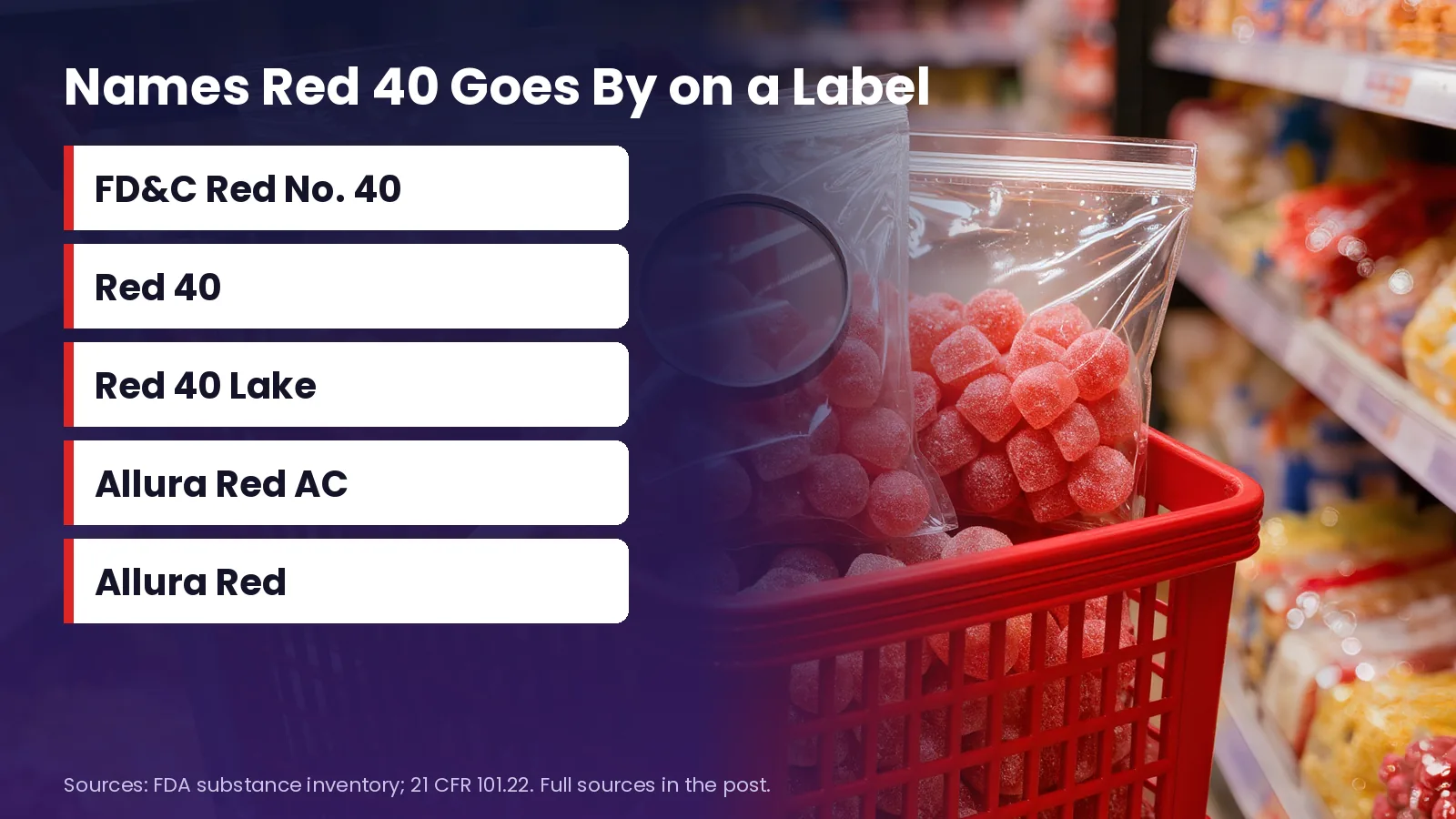
So look for any of these: FD&C Red No. 40, Red 40, Red 40 Lake, Allura Red AC, Allura Red. Picture a box of strawberry cereal in the grocery aisle. Flip it over. Read the ingredient list to the end. The front of the box won't tell you. The ingredient list will.
Want to limit color additives for your kids? The FDA gives two steps. Check ingredient lists. And talk with your family physician about any concerns [2].
Would you rather not read every label by hand? The NutraDetective app helps you check the ingredient list for Red 40.
Frequently Asked Questions
A. Synthetic food dyes like Red 40 are made today mainly from raw materials that come from petroleum. The FDA's list of food substances gives "Allura Red AC" and "Allura Red" as other names for it.
A. No. Red 40 is still allowed in U.S. food. The FDA's phase-out of six synthetic dyes is voluntary, and companies have made voluntary pledges. The FDA's tracker now gives the end of 2027 as the target.
A. No study on our list shows that. A 2012 review estimated that about 8% of children with ADHD may have symptoms related to synthetic food colors. The same review found the effect was not reliable in studies limited to FDA-approved colors. The FDA says most children have no adverse effects, but certain children may be sensitive.
A. Labels can say FD&C Red No. 40 or Red 40. A lake form must say Red 40 Lake. Labels may also add "Allura Red" in parentheses, and the FDA lists Allura Red AC as another name.
A. EFSA uses an acceptable daily intake of 7 mg per kg of body weight per day. JECFA's limit is 0 to 7 mg per kg of body weight, set in 1981 and confirmed in 2016. In 2015, EFSA found no group's exposure went above that limit.
A. In the European Union, foods with Allura Red AC (E 129) must carry a warning. It says the dye may have an adverse effect on activity and attention in children.
A. West Virginia is the one we checked. Its House Bill 2354 bans seven synthetic dyes, including Red 40, from school meals since August 1, 2025. The ban reaches food sold in the state on January 1, 2028.
References
- Code of Federal Regulations. 21 CFR 74.340, FD&C Red No. 40. https://www.ecfr.gov/current/title-21/chapter-I/subchapter-A/part-74/subpart-A/section-74.340
- U.S. Food and Drug Administration. Color Additives Questions and Answers for Consumers. https://www.fda.gov/food/color-additives-information-consumers/color-additives-questions-and-answers-consumers
- U.S. Food and Drug Administration. Color Additives History. https://www.fda.gov/industry/color-additives/color-additives-history
- U.S. Food and Drug Administration. HHS, FDA to Phase Out Petroleum-Based Synthetic Dyes in Nation's Food Supply. April 22, 2025. https://www.fda.gov/news-events/press-announcements/hhs-fda-phase-out-petroleum-based-synthetic-dyes-nations-food-supply
- U.S. Food and Drug Administration. Tracking Food Industry Pledges to Remove Petroleum-Based Food Dyes. Content current as of October 16, 2026. https://www.fda.gov/food/color-additives-information-consumers/tracking-food-industry-pledges-remove-petroleum-based-food-dyes
- U.S. Food and Drug Administration. Substances Added to Food inventory: FD&C Red No. 40. https://www.hfpappexternal.fda.gov/scripts/fdcc/index.cfm?set=FoodSubstances&id=FDCREDNO40
- European Food Safety Authority. Refined exposure assessment for Allura Red AC (E 129). EFSA Journal 2015;13(2):4007. https://efsa.europa.eu/en/efsajournal/pub/4007
- WHO, Joint FAO/WHO Expert Committee on Food Additives (JECFA). Allura Red AC. https://apps.who.int/food-additives-contaminants-jecfa-database/Home/Chemical/2361
- Regulation (EC) No 1333/2008, Annex V, consolidated text of August 18, 2026. https://eur-lex.europa.eu/legal-content/EN/TXT/HTML/?uri=CELEX:02008R1333-20260818
- McCann D, et al. Food additives and hyperactive behaviour in 3-year-old and 8/9-year-old children in the community. The Lancet. 2007;370:1560-7. https://pubmed.ncbi.nlm.nih.gov/17825405/
- California Office of Environmental Health Hazard Assessment. Report links synthetic food dyes to hyperactivity and other neurobehavioral effects in children. April 16, 2021. https://oehha.ca.gov/risk-assessment/press-release/report-links-synthetic-food-dyes-hyperactivity-and-other-neurobehavioral-effects-children
- Nigg JT, et al. Meta-analysis of attention-deficit/hyperactivity disorder or attention-deficit/hyperactivity disorder symptoms, restriction diet, and synthetic food color additives. Journal of the American Academy of Child and Adolescent Psychiatry. 2012;51(1):86-97. https://pubmed.ncbi.nlm.nih.gov/22176942/
- Office of the Governor of West Virginia. Governor Patrick Morrisey Signs Food Dye Legislation Into Law. March 24, 2025. https://governor.wv.gov/article/governor-patrick-morrisey-signs-food-dye-legislation-law
- Code of Federal Regulations. 21 CFR 101.22(k)(1). https://www.ecfr.gov/current/title-21/chapter-I/subchapter-B/part-101/subpart-B/section-101.22