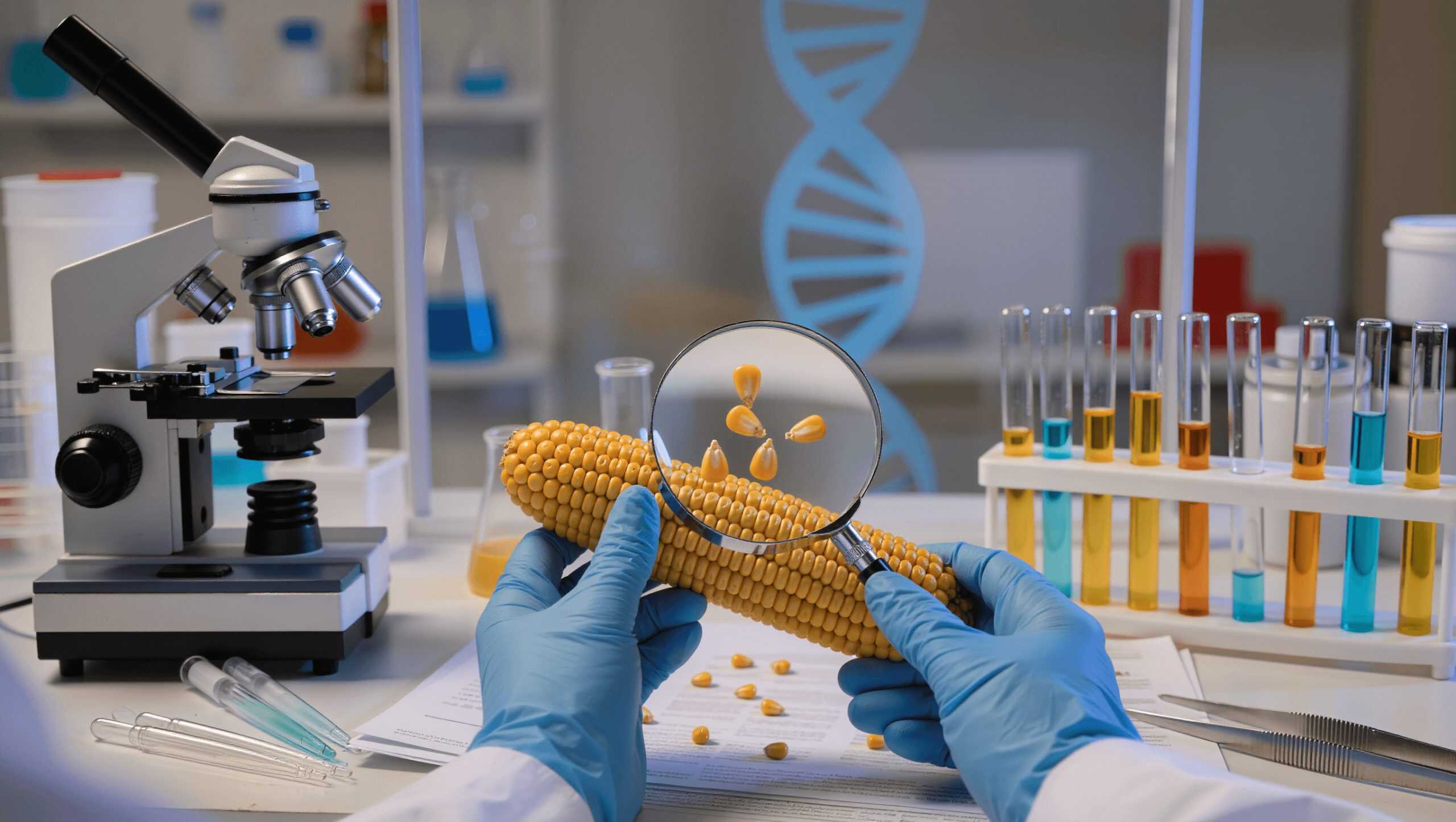
The question seems straightforward enough. Are GMOs safe to eat?
You’d think after three decades of widespread consumption, we’d have a clear answer. The biotech industry certainly acts like we do. Government agencies approve these crops. Grocery stores stock them. Most Americans eat them daily without even knowing it.
But when you start examining the actual research—not the press releases, not the industry talking points, but the peer-reviewed scientific studies—a different picture emerges. The data is messier than you’ve been told. The long-term studies don’t exist. And the scientists who’ve looked closely? Many of them have serious questions.
Want to know which foods actually contain GMOs? Start with our complete GMO Foods List: What to Avoid at the Grocery Store.
Let’s investigate what the science actually reveals.
What Does “Safe” Really Mean When It Comes to Food?
Let’s talk about the word “safe.”
When the FDA evaluates GMOs, they don’t ask “Is this safe?” They ask “Is this substantially equivalent to the non-GMO version?” If the nutritional profile looks similar in a lab test—similar protein, similar fat, similar carbohydrates—it passes.
That’s it. Similar composition equals regulatory approval.
But here’s what “substantially equivalent” doesn’t measure: How will novel proteins affect your immune system over 30 years? What happens when you eat multiple GMO ingredients together, daily, for your entire life? Will effects show up in your children? Your grandchildren?
These questions go unanswered. The testing doesn’t look that far ahead.
Most GMO safety studies run for 90 days. That’s about three months in a rat’s life. Many human diseases take decades to develop. Cancer. Autoimmune disorders. Fertility concerns. Chronic conditions don’t announce themselves in three-month windows.
Think about it this way: If you tested a new medication for only three months, would you catch side effects that take a year to appear? The absence of evidence isn’t the same as evidence of absence.
This distinction matters. “We haven’t found evidence of harm” is very different from “We’ve proven this is safe.” The first admits we haven’t looked hard enough or long enough. The second claims we’ve done the work and found nothing.
Most GMO safety claims fall into the first category.
What the Biotech Industry Wants You to Believe
The biotech industry has crafted a compelling narrative. You’ve probably heard it before.
This statement shows up everywhere—news articles, blog posts, industry websites. It’s designed to end the conversation before it starts. After all, who argues against scientific consensus? The phrase carries weight.
Then there’s the “trillions of GMO meals” argument.
Americans have been eating GMO foods since the mid-1990s, they say. Billions of animals have consumed GMO feed. Trillions of meals served. If GMOs were dangerous, wouldn’t we know by now?
It sounds logical. That’s why it works.
You’ll also hear that GMOs are “the most studied foods in history.” The industry points to hundreds of studies. Regulatory approvals from agencies worldwide. Extensive testing before products reach the market.
When the FDA or EPA approves a GMO crop, the message becomes simple: “The FDA has determined these foods are safe.” Agency names carry authority. Most people trust that regulators wouldn’t approve something dangerous.
Here’s what makes this narrative powerful: it all sounds reasonable. Scientific consensus. Decades of consumption. Rigorous testing. Government approval.
These talking points work because they contain kernels of truth wrapped in layers of interpretation. They’re designed to make you feel confident about GMO safety without examining the research too closely.
But when you start examining the actual evidence, cracks appear.
Uncovering What Independent Scientists Discovered
In 2015, over 300 independent scientists and researchers signed a statement in the peer-reviewed journal Environmental Sciences Europe.
Their conclusion? There is no scientific consensus on GMO safety (Hilbeck et al., 2015).
The research on GMO safety is contradictory. Incomplete. And the way studies are funded affects the results. These aren’t fringe activists making these claims—these are credentialed scientists with expertise in genetics, toxicology, and environmental science.
Here’s something that should concern you: No epidemiological studies exist on GMO consumption in humans. None.
Epidemiology is how we study whether something affects human health. It’s how we discovered smoking causes cancer. It’s how we track disease patterns in populations. Without these studies, claims about “trillions of GMO meals” being eaten safely have no scientific foundation (Hilbeck et al., 2015).
You can’t track health effects when GMO foods aren’t labeled and consumption isn’t monitored.
The lack of long-term research isn’t unique to GMOs. Learn about other hidden ingredients affecting your family in 10 Harmful Food Additives Hiding in Your Pantry.
A systematic review looked at animal feeding studies from 1983 to 2020. Researchers examined 204 studies involving over 54,000 animals (Shen et al., 2022).
They found 37 adverse events. More than half were classified as serious.
Serious adverse events included death, tumors, reduced fertility, decreased learning abilities, and organ damage in the liver, kidneys, and reproductive systems. The GMO products connected to these effects? Varieties of corn, soy, and rice approved for human consumption in multiple countries (Shen et al., 2022).
All 204 studies had unclear or high risk of bias (Shen et al., 2022). Even the available animal research doesn’t meet rigorous scientific standards.
When you insert foreign genes into plants, you create proteins that never existed before in the food supply. Some researchers worry these new proteins could trigger allergic reactions in sensitive people (Goodman et al., 2008). The approval process tests for allergenicity, but critics argue the assessments don’t predict long-term effects adequately.
Independent research shows contradictory results. Unanswered questions. Serious concerns that haven’t been addressed.
Following the Money: Industry-Funded vs. Independent Studies
Who pays for the research matters.
A comprehensive review of GMO animal feeding studies found something interesting: Most studies concluding GMO foods were safe came from biotechnology companies or their associates—the same companies commercializing these products (Hilbeck et al., 2015). Studies raising concerns? Those came from independent research groups with no financial ties to biotech companies.
Funding affects more than results. It affects attitudes.
A peer-reviewed survey of 62 life scientists examined views on GMO safety. Scientists with industry funding held very positive attitudes toward GM crops and believed they posed no unique risks. Scientists funded by public sources, working independently of biotech companies, were more likely to emphasize uncertainty and potential risks (Hilbeck et al., 2015).
Biotech companies also control access to research materials. Independent researchers can’t get GMO seeds unless they sign contractual agreements giving companies control over publication (Hilbeck et al., 2015).
The Royal Society of Canada stated it’s “scientifically unjustifiable” to presume GMO foods are safe without rigorous testing. The British Medical Association concluded that “many unanswered questions remain” about long-term effects on human health and the environment (Hilbeck et al., 2015).
Industry-funded studies reach industry-friendly conclusions. Independent researchers raise concerns.
What GMO Safety Questions Mean for Your Family
So where does this leave you at the grocery store?
ou’re standing in the aisle. You need to feed your family. The science is incomplete. Long-term human studies don’t exist. Animal studies show concerning effects. Industry and independent researchers disagree.
How do you make decisions when the data isn’t clear?
This is where the precautionary principle comes in. When potential harm is serious and the science is uncertain, proceed with caution. You don’t wait for proof of harm. You act carefully until safety is demonstrated.
Many countries apply this principle to GMOs. The European Union requires extensive safety assessments before approval. Some nations ban GMO crops entirely. They’ve decided that without long-term proof of safety, caution makes sense.
Understanding food labels is essential for protecting your family. Learn what manufacturers hide behind vague terms in The Truth About “Natural Flavors” on Food Labels.
Here’s the practical reality: You can’t avoid uncertainty. But you can control your exposure.
Genetic modification changes food at a fundamental level. It crosses boundaries that don’t occur in nature. The principle of seed purity—that food should remain as designed, reproducing according to its kind—offers a framework for evaluating these changes. The Eden Health Guide explores this concept as one of seven pillars for food choices. You can access it free at NutraDetective.com.
When research gaps are this substantial, choosing organic and Non-GMO options isn’t extreme. It’s prudent.
Evaluating GMO Safety Claims: Your Action Plan
When you hear “scientific consensus on GMO safety,” ask questions.
Who funded the studies? Industry-funded research tends to reach industry-friendly conclusions. Look for independent research from publicly-funded scientists with no financial ties to biotech companies.
Are there long-term human studies? If someone claims GMOs are proven safe, ask about epidemiological studies. They don’t exist. Without population-level tracking over decades, safety claims lack the foundation we’d expect for any other widespread dietary change.
What about study duration? Ninety-day animal studies can’t capture effects that take years to develop. Be skeptical of short-term testing presented as comprehensive safety evidence.
Check the source. Is the information coming from biotech industry websites or independent scientific reviews? The difference matters.
Read ingredient labels carefully. Corn, soy, canola, and sugar are the four major GMO crops. If these ingredients aren’t labeled organic or Non-GMO Project Verified, assume they’re genetically modified. Corn syrup, soybean oil, canola oil, and sugar (not specified as cane sugar) are especially common. For a comprehensive list of GMO foods and ingredients to watch for, check out our complete GMO Foods List guide.
These same ingredients can affect your children’s behavior. Learn how Food Additives Can Trigger ADHD Symptoms in Children.
Choose organic and Non-GMO when possible. USDA Organic certification prohibits genetic modification. The Non-GMO Project Verified label adds an extra layer of testing. These options give you control when the science remains uncertain.
The NutraDetective app can help. Scan product barcodes to instantly identify GMO ingredients. The app flags corn, soy, canola, and sugar—the four major GMO crops hiding in processed foods. It’s a quick way to make informed choices in the grocery aisle.
Learn more about our mission for food transparency in Why We Built NutraDetective: A Food Scanner App for Ingredient Analysis.
Start with the products your family eats most often. You don’t have to overhaul everything at once. Focus on staples—breakfast cereals, snacks, cooking oils. Swap one or two items per shopping trip. Small changes add up.
You don’t need to accept blanket safety claims. You can evaluate the evidence yourself. Ask who funded the research. Look for gaps in the data. Consider the precautionary principle.
The science on GMO safety isn’t settled. Don’t let anyone tell you otherwise.
References
Goodman, R. E., Vieths, S., Sampson, H. A., Hill, D., Ebisawa, M., Taylor, S. L., & van Ree, R. (2008). Allergenicity assessment of genetically modified crops—What makes sense? Nature Biotechnology, 26(1), 73-81. https://doi.org/10.1038/nbt1343
Hilbeck, A., Binimelis, R., Defarge, N., Steinbrecher, R., Székács, A., Wickson, F., Antoniou, M., Bereano, P. L., Clark, E. A., Hansen, M., Novotny, E., Heinemann, J., Meyer, H., Shiva, V., & Wynne, B. (2015). No scientific consensus on GMO safety. Environmental Sciences Europe, 27(4). https://doi.org/10.1186/s12302-014-0034-1
Shen, C., Yin, X., Jiao, B., Ren, J., Li, J., Zhang, X., Jia, P., Peng, J., Li, Y., Cheng, X., Li, X., Guo, Y., & Liu, J. (2022). Evaluation of adverse effects/events of genetically modified food consumption: A systematic review of animal and human studies. Environmental Sciences Europe, 34(8). https://doi.org/10.1186/s12302-021-00578-9
Trasande, L., Aldana, C. C., Hahn-Holbrook, J., Gursky, H., Sun, Y., & Ghassabian, A. (2024). Glyphosate exposure and maternal and fetal thyroid hormone levels: The role of the gut microbiome. Pediatrics, 153(4), e2023064637. https://doi.org/10.1542/peds.2023-064637
Frequently Asked Questions
A. The science on GMO safety isn’t settled. No long-term human studies exist, and over 300 independent scientists signed a statement confirming there is no scientific consensus on GMO safety. Most safety studies run only 90 days—too short to detect effects that take years to develop.
A. The FDA uses “substantial equivalence” to approve GMOs, meaning if a GMO crop has similar nutritional content (protein, fat, carbohydrates) to its non-GMO counterpart, it passes approval. This standard doesn’t test for long-term health effects, immune system impacts, or multigenerational consequences.
A. GMO foods aren’t labeled in most products, making it impossible to track who consumes them and monitor health effects. Without labeling, epidemiological studies—the same type that proved smoking causes cancer—cannot be conducted on GMO consumption in human populations.
A. Yes. Research shows that studies concluding GMOs are safe typically come from biotech companies or their associates, while studies raising concerns come from independent researchers with no financial ties to the industry. Scientists with industry funding also hold more positive attitudes toward GMO safety than publicly-funded scientists.
A. The precautionary principle states that when potential harm is serious and science is uncertain, you should proceed with caution rather than wait for proof of harm. Many countries—including the entire European Union—apply this principle to GMOs, requiring extensive safety assessments or banning GMO crops entirely.
A. A systematic review of 204 animal feeding studies found 37 adverse events, with more than half classified as serious. These included death, tumors, reduced fertility, decreased learning abilities, and organ damage to the liver, kidneys, and reproductive systems—from GMO corn, soy, and rice varieties approved for human consumption.
A. Look for USDA Organic or Non-GMO Project Verified labels. Focus on avoiding the four major GMO crops: corn, soy, canola, and sugar (unless labeled cane sugar). Use the NutraDetective app to scan products and identify GMO ingredients instantly. Start with the foods your family eats most often and swap one or two items per shopping trip.