
Fact-checked November 2026.
Is soy lecithin bad for you? The rules say no. FDA lists lecithin as GRAS, "generally recognized as safe" [1]. Its only limit is good manufacturing practice [1]. That means food makers can add only as much as they need to do its job in the food [18].
Europe's food safety agency re-checked it in 2017 and set no daily limit [2]. Two things are worth knowing anyway. Soy lecithin can carry tiny traces of soy protein, so labels name soy [2, 4, 7]. And the gut research is mixed [11, 12].
We read the federal rule, two agency reviews, FDA's allergy records and a USDA report. We also read five studies and three labels.
What Is Soy Lecithin?
Soy lecithin is an emulsifier, a helper that keeps fat and water mixed. The federal rule, 21 CFR 184.1400, calls lecithin a natural mix of phosphatides [1]. Phosphatides are fat-like molecules.
Here's how the rule says it's made. Oil is pulled from soy, safflower or corn with a solvent [1]. Water is added, and the lecithin separates out as a gum [1]. The gum can be bleached with hydrogen peroxide and benzoyl peroxide, then dried by heating [1].
EFSA says food lecithin comes mainly from soybean oil [2]. Cottonseed, corn, sunflower, rapeseed and egg are minor sources [2].
Lecithin isn't only an additive. EFSA says lecithins are natural parts of all cells in the human body [2].
Is Soy Lecithin Made With Hexane?
A USDA report says yes, at the oil step [8]. Soy lecithin comes from soybean oil, and makers use a solvent to get that oil out of the beans [1]. A solvent is a liquid that dissolves another substance, such as oil. The federal rule doesn't say which solvent [1].
A USDA organic program technical report does. It says makers pull extra oil from flaked soybeans using hexane [8].
De-oiled lecithin is the powder or granule form [8]. For it, the report describes two solvents [8]. Hexane pulls the oil, then acetone pulls oil from the lecithin [8]. Organic fluid lecithin, it says, is made by physical methods instead [8].
How much is left? The report's table shows less than 1 mg/kg of hexane left in lecithin from 2007 to 2009 industry batches [8]. Less than 1 mg/kg is the same as less than 1 part per million. EFSA reports a similar figure: hexane below 1 mg/kg [2]. Ethanol was at or below 3.8 mg/kg, and acetone at or below 2.5 mg/kg [2].
The report also says modern equipment can leave under 20 ppm of hexane in the oil [8]. The 20 ppm figure is for the oil, before lecithin is made from it [8].
One number to keep separate. FDA's hexane rule, 21 CFR 173.270, allows up to 25 ppm in spice oleoresins [9]. It does not mention lecithin [9]. No source we read measures harm from hexane residue in lecithin.
Is Soy Lecithin Safe to Eat?
By the rules, yes. Lecithin sits in Part 184 of the federal code [1]. That's the list of substances affirmed as GRAS. The rule's only limit is current good manufacturing practice [1].
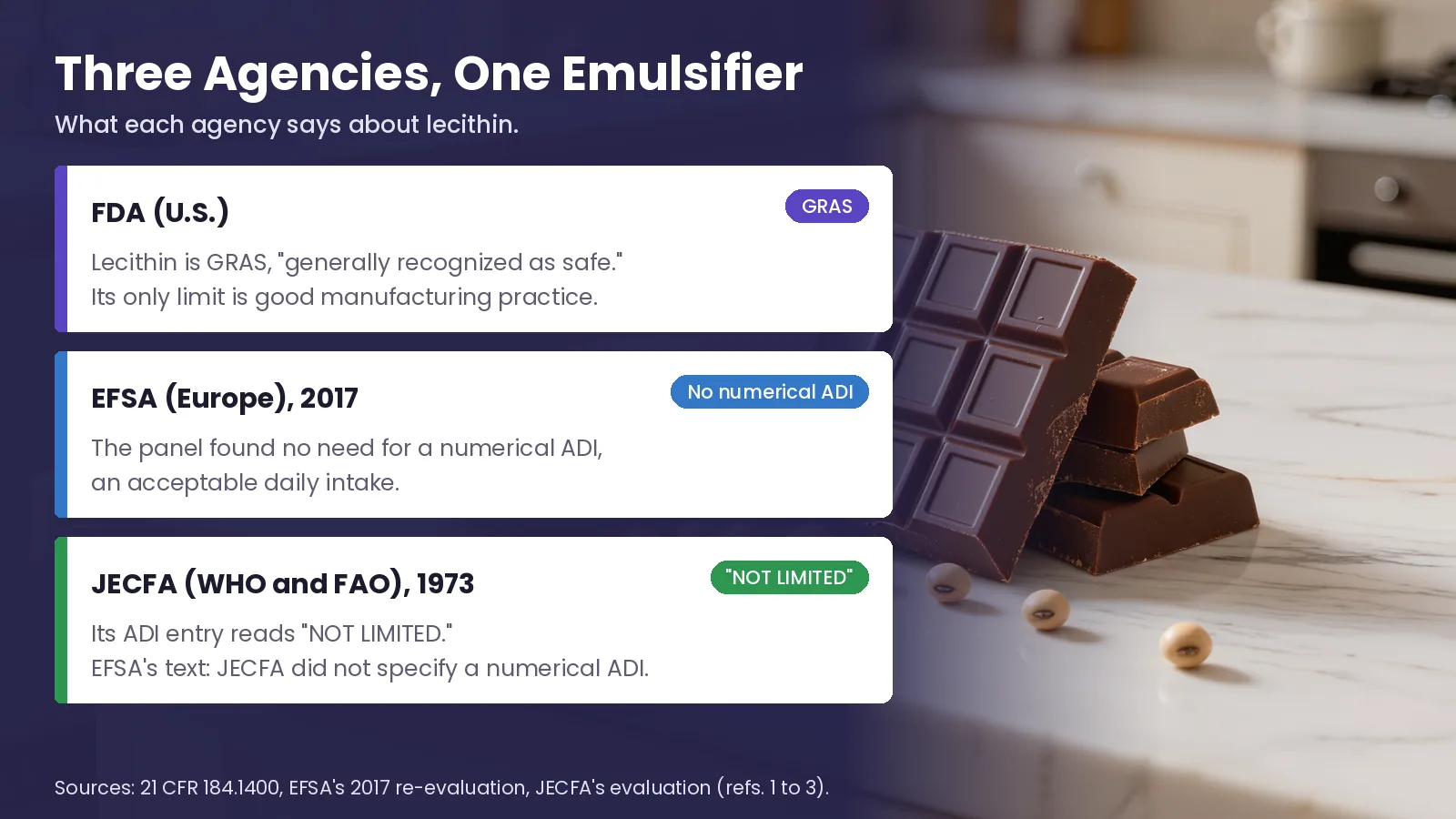
EFSA is Europe's food safety agency. It published its re-evaluation of lecithins (E 322) in April 2017 [2]. Its panel found no need for a numerical ADI, an acceptable daily intake [2]. The panel found no safety concern for people over 1 year old at reported uses [2].
Infants were checked too. From 12 weeks to 11 months, the panel found no safety concern at reported uses [2].
The panel's conclusion cites a rat study. The highest dose tested was 3,750 mg per kg of body weight per day [2]. It caused no adverse effects [2]. EFSA's highest exposure estimate was for toddlers: up to 175 mg per kg per day [2].
By our math, the 3,750 mg rat dose is about 21 times the toddler estimate. It's the highest dose tested, not a safe limit.
JECFA is the WHO and FAO expert committee on additives. It reviewed lecithin in 1973 [3]. Its ADI entry reads "NOT LIMITED" [3]. EFSA's text puts it this way: JECFA did not specify a numerical ADI [2].
One note from EFSA's 2017 review. The panel recommended new EU limits for lead, mercury and arsenic in lecithins [2]. That's about the specification, not a finding of harm.
Why Does the Label Say "Contains: Soy"?
Because soy lecithin can carry traces of soy protein. FARRP is the University of Nebraska's food allergy program. It says most soy protein is removed in manufacturing [7].
Still, FARRP says soy lecithin holds trace levels of soy proteins [7]. Those include soy allergens [7].
EFSA cites one study of six commercial lecithin samples [2]. Protein ranged from 100 to 1,400 ppm, or parts per million [2]. EFSA also notes there is no specification for leftover protein in the additive [2].
So here's the U.S. rule, in plain words. A "major food allergen" includes soybeans, and any ingredient with protein from soybeans [4]. The food source has to be named in the ingredient list [4]. Or it goes in a "Contains" line right after [4].
"Soy," "soya" and "soybean" all count [4]. FDA's guidance is nonbinding; it explains the law, section 403(w) [4]. Nonbinding means the guidance itself is advice [4]. The law it explains is not. FDA can take action against a label that breaks it [4].
What about people with a soy allergy? Soy lecithin apparently lacks enough soy protein to set off most soy-allergic people, FARRP says [7]. Many allergists don't advise these patients to avoid it [7].
But some of the more sensitive ones might react [7]. That's why FARRP supports naming soy on the label [7].
If you have a soy allergy, ask your allergist whether soy lecithin is safe for you.
Can Soy Lecithin Be Exempt From Allergy Labeling?
There's a way around the label, but it's narrow. FDA's guidance says an ingredient with allergen protein can be exempted through a petition [4]. The law behind it is FALCPA [5]. That's the Food Allergen Labeling and Consumer Protection Act of 2004 [4].
FDA's inventory lists four soy lecithin petitions [5]. FARRP said in 2018 that FDA had granted two [7].
One went to Solae, LLC on February 22, 2013 [7]. It covers select soy lecithins used as a release agent on food contact surfaces [7]. A release agent helps keep food from sticking to pans and equipment [7, 17]. One went to ADM on June 6, 2017 [7]. It covers several ADM soy lecithin products in a release agent on food contact surfaces [7].
FDA's ADM letter covers twelve named products [6]. The products must be made as the petition describes [6]. FDA concluded these twelve products won't cause an allergic response that poses a risk to human health [6]. The finding covers the release-agent use only [6].
Both exemptions are for release agents on food contact surfaces [6, 7]. They are not for soy lecithin in general.
A fourth petition came from Guittard Chocolate Company in 2022 [5]. It shows as pending on FDA's January 2024 page [5].
What Does the Research Say About Soy Lecithin and Your Gut?
It depends on where the test was run. Lab dishes, mice and people gave different answers.
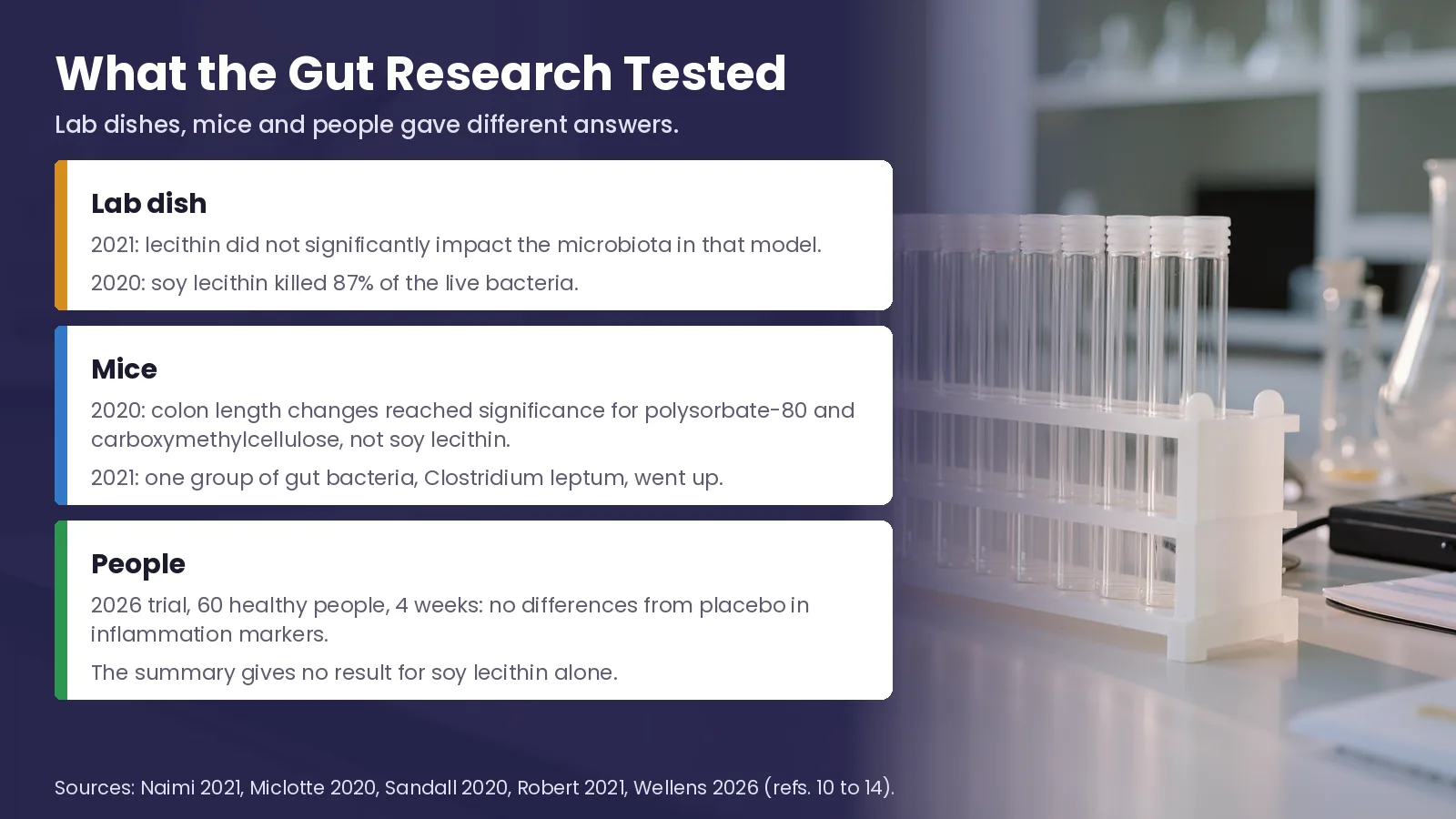
In the lab dish. A 2021 study kept human gut bacteria alive outside the body and tested 20 emulsifiers [11]. Some, such as lecithin, did not significantly impact the microbiota in that model [11].
A 2020 study exposed stool bacteria from 10 people to five emulsifiers for 48 hours [12]. Soy lecithin killed 87% of the live bacteria [12]. It also raised the share of putative pathogens, which are possible disease-causing germs [12].
Those two results point in different directions. Both are lab models, not people.
In mice. A 2020 study put soy lecithin and three other emulsifiers in mice's water [13]. It ran 12 weeks [13]. All four lowered colon length compared with control [13]. Only two reached significance: polysorbate-80 and carboxymethylcellulose, not soy lecithin [13].
A 2021 study fed mice 10% soy lecithin for 5 days [14]. One group of gut bacteria, Clostridium leptum, went up [14]. The authors don't call the change harmful or helpful.
Both lecithin results come from mice, not people [13, 14]. Mice and people can respond differently, so these results don't show what happens in humans.
In people. A 2026 trial gave 60 healthy people brownies for 4 weeks [10]. Each brownie held one of five emulsifiers, or none [10]. One group got brownies with soy lecithin [10].
Short chain fatty acids were lower with carboxymethylcellulose than with the brownie that had none [10]. The other emulsifiers showed the same pattern [10]. But for some of them, the results weren't strong enough to rule out chance [10].
The study's summary gives no result for soy lecithin alone [10]. At the end, the trial found no differences between placebo and emulsifiers in inflammation markers, cholesterol or other metabolic markers [10].
The authors concluded emulsifier supplementation lowered short chain fatty acids [10]. It did not impact inflammation or metabolic endpoints [10]. They called for more research on limiting emulsifiers in the diet [10]. Our polysorbate 80 post covers the trial's design.
No source we read says soy lecithin causes gut problems or cancer in people.
How to Read a Soy Lecithin Label
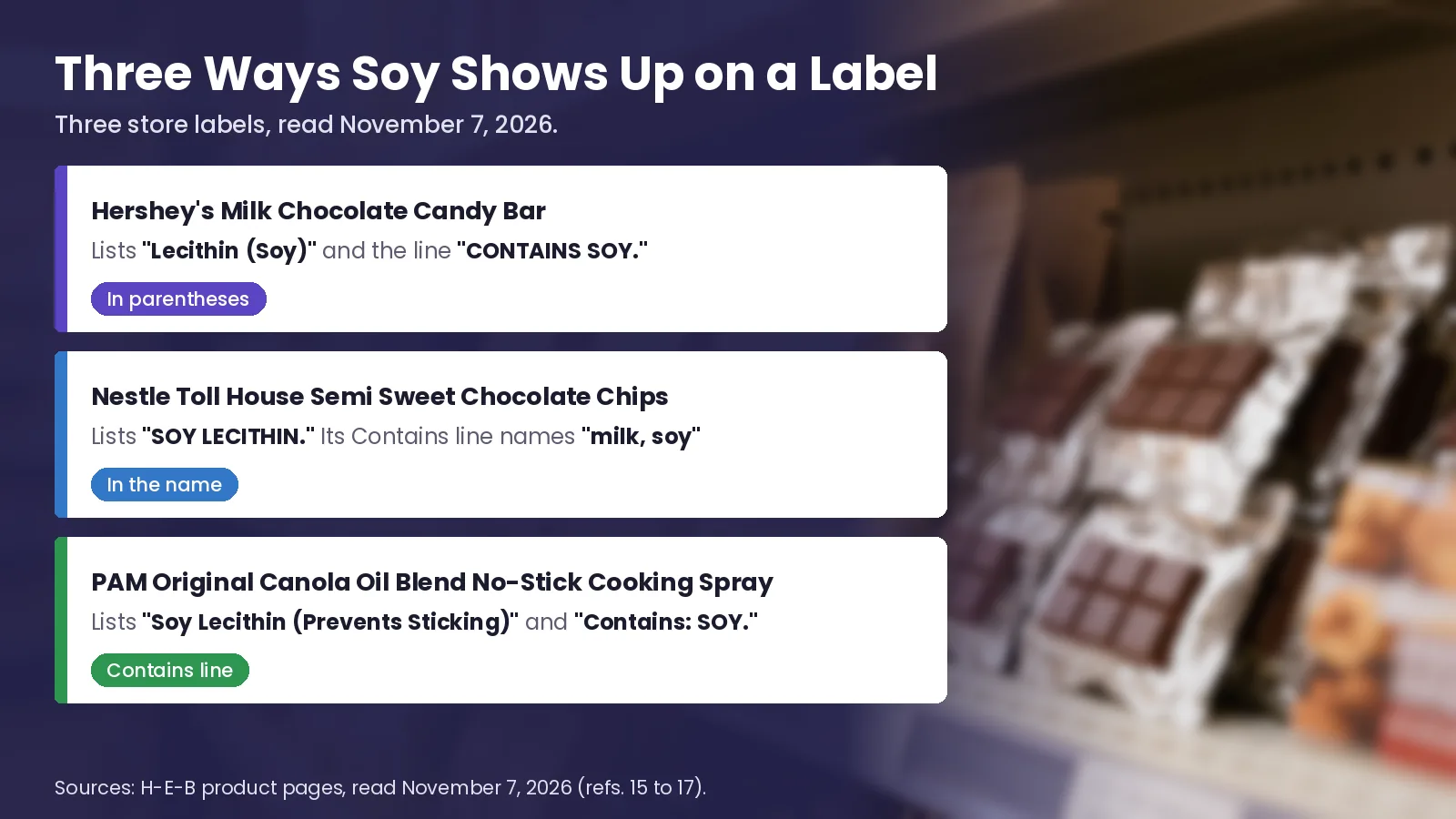
We read three store labels on November 7, 2026.
- Hershey's Milk Chocolate Candy Bar: lists "Lecithin (Soy)" and the line "CONTAINS SOY." [15]
- Nestle Toll House Semi Sweet Chocolate Chips: lists "SOY LECITHIN." Its Contains line names "milk, soy" [16]
- PAM Original Canola Oil Blend No-Stick Cooking Spray: lists "Soy Lecithin (Prevents Sticking)" and "Contains: SOY." [17]
- Find the word. Look for "lecithin" in the ingredient list.
- Note its form. "Lecithin (Soy)" names the source in parentheses, as on the Hershey's Milk Chocolate Candy Bar [15]. "SOY LECITHIN" puts it in the name, as on the Nestle Toll House Semi Sweet Chocolate Chips [16].
- Check the Contains line. Soy has to appear there or in the list [4]. PAM Original Canola Oil Blend No-Stick Cooking Spray does both: it lists soy lecithin and says "Contains: SOY." [17]
- Soy allergy? Ask your allergist about lecithin. Don't go by the label alone.
- Scan the barcode with NutraDetective to see the additives on the label.
We read a Ghirardelli cocoa label with soy lecithin in our hot cocoa mix post. Emulsifiers are one marker in our ultra-processed foods guide.
Frequently Asked Questions
A. The rules say no. FDA lists lecithin as GRAS with no limit beyond good manufacturing practice. EFSA found no need for a daily limit in 2017. The gut research is mixed, and no source we read shows harm in people.
A. Ask your allergist. The University of Nebraska's food allergy program says soy lecithin carries trace soy protein. It says most soy-allergic people don't react, but some of the more sensitive ones might.
A. It's an emulsifier, a helper that keeps fat and water mixed. Hershey's Milk Chocolate Candy Bar lists it. So do Nestle Toll House Semi Sweet Chocolate Chips. Both labels also name soy.
A. A USDA report says yes, at the oil step. A USDA organic program report says hexane pulls the oil from flaked soy. Industry data from 2007 to 2009 showed less than 1 mg/kg of hexane left in lecithin. FDA's 25 ppm hexane rule is for spice oleoresins, not lecithin.
A. Lab results disagree. One 2021 lab model found no significant effect; a 2020 lab-dish study found large changes. In a 2026 trial in people, inflammation markers were no different from placebo. No source we read shows harm in people.
A. EFSA says lecithins are natural parts of all cells in the body and of food. Commercial lecithin is separated as a gum after water is added to solvent-extracted soy, safflower or corn oil [1]. Then it's bleached if desired, and dried.
A. The U.S. rule names soy, safflower and corn oils as sources. EFSA lists sunflower as a minor source. No source we read compares their safety.
References
- Code of Federal Regulations. 21 CFR 184.1400, Lecithin. eCFR, current text through November 1, 2026. https://www.ecfr.gov/current/title-21/chapter-I/subchapter-B/part-184/subpart-B/section-184.1400
- EFSA Panel on Food Additives and Nutrient Sources added to Food (ANS). Re-evaluation of lecithins (E 322) as a food additive. EFSA Journal. 2017;15(4):4742. doi:10.2903/j.efsa.2017.4742. https://doi.org/10.2903/j.efsa.2017.4742
- Joint FAO/WHO Expert Committee on Food Additives (JECFA). Summary of Evaluations: Lecithin, INS 322. IPCS INCHEM. Page dated February 6, 2004. https://inchem.org/documents/jecfa/jeceval/jec_1261.htm
- U.S. Food and Drug Administration. Questions and Answers Regarding Food Allergens, Including the Food Allergen Labeling Requirements of the Federal Food, Drug, and Cosmetic Act (Edition 5): Guidance for Industry. January 2025. https://www.fda.gov/media/117410/download
- U.S. Food and Drug Administration. Inventory of Petitions Received under 21 U.S.C. 343(w)(6) for Exemptions from Food Allergen Labeling. Content current as of January 22, 2024. https://www.fda.gov/food/allergens/inventory-petitions-received-under-21-usc-343w6-exemptions-food-allergen-labeling
- U.S. Food and Drug Administration, Office of Food Additive Safety. Response letter to Archer Daniels Midland Company, petition FALP 004. June 6, 2017; corrected June 21, 2017. Archived copy. https://web.archive.org/web/20191214032616/https://www.fda.gov/media/105398/download
- Food Allergy Research & Resource Program (FARRP), University of Nebraska–Lincoln. Soy Lecithin. Updated August 7, 2018. https://farrp.unl.edu/soy-lecithin
- USDA Agricultural Marketing Service, National Organic Program. Lecithin – de-oiled, Handling/Processing: Full Scope Technical Evaluation Report. January 1, 2023. Compiled by OMRI. https://www.ams.usda.gov/sites/default/files/media/2023Technical_Report_Lecithin_deoiled_Handling.pdf
- Code of Federal Regulations. 21 CFR 173.270, Hexane. eCFR, current text through November 1, 2026. https://www.ecfr.gov/current/title-21/chapter-I/subchapter-B/part-173/subpart-C/section-173.270
- Wellens J, Vanderstappen J, Hoekx S, et al. Effect of Five Dietary Emulsifiers on Inflammation, Permeability, and the Gut Microbiome: A Placebo-controlled Randomized Trial. Clinical Gastroenterology and Hepatology. 2026;24(4):1092-1101. PMID 40816342. https://pubmed.ncbi.nlm.nih.gov/40816342/
- Naimi S, Viennois E, Gewirtz AT, Chassaing B. Direct impact of commonly used dietary emulsifiers on human gut microbiota. Microbiome. 2021;9(1):66. PMID 33752754. https://pubmed.ncbi.nlm.nih.gov/33752754/
- Miclotte L, De Paepe K, Rymenans L, et al. Dietary Emulsifiers Alter Composition and Activity of the Human Gut Microbiota in vitro, Irrespective of Chemical or Natural Emulsifier Origin. Frontiers in Microbiology. 2020;11:577474. PMID 33250870. https://pubmed.ncbi.nlm.nih.gov/33250870/
- Sandall AM, Cox SR, Lindsay JO, et al. Emulsifiers Impact Colonic Length in Mice and Emulsifier Restriction is Feasible in People with Crohn's Disease. Nutrients. 2020;12(9):2827. PMID 32942699. https://pubmed.ncbi.nlm.nih.gov/32942699/
- Robert C, Buisson C, Laugerette F, et al. Impact of Rapeseed and Soy Lecithin on Postprandial Lipid Metabolism, Bile Acid Profile, and Gut Bacteria in Mice. Molecular Nutrition & Food Research. 2021;65(9):e2001068. PMID 33742729. https://pubmed.ncbi.nlm.nih.gov/33742729/
- H-E-B. Hershey's Milk Chocolate Candy Bar, 1.55 oz (product page). Read November 7, 2026. https://heb.com/product-detail/hershey-s-milk-chocolate-full-size-candy-bar-1-55-oz/112558
- H-E-B. Nestle Toll House Semi Sweet Chocolate Chips, 12 oz (product page). Read November 7, 2026. https://heb.com/product-detail/nestle-toll-house-semi-sweet-morsels/371100
- H-E-B. PAM Original Canola Oil Blend No-Stick Cooking Spray, 6 oz (product page). Read November 7, 2026. https://heb.com/product-detail/pam-non-stick-original-cooking-spray/153043
- Code of Federal Regulations. 21 CFR 184.1, Substances added directly to human food affirmed as generally recognized as safe (GRAS). eCFR, current text. https://www.ecfr.gov/current/title-21/chapter-I/subchapter-B/part-184/subpart-A/section-184.1