Fact-checked November 2026.
Carrageenan is an approved food additive in the U.S. and in Europe. So is carrageenan bad for you? The rules say no.
FDA's rule says it "may be safely used in food" [1]. EFSA, Europe's food safety agency, found no cancer concern in 2018 [2].
EFSA did call its daily limit temporary, because of data gaps [2]. And the human studies are small, or they show links rather than causes [11, 12, 13, 14].
Many of the gut-damage and cancer findings in animals are about a different substance, degraded carrageenan [2, 5]. It isn't a food additive [2, 5].
We read two federal rules and the EFSA and JECFA reviews. We also read the organic board's records, four human studies and five store listings.
What Is Carrageenan?
Carrageenan comes from red seaweed. The federal rule, 21 CFR 172.620, calls it a refined hydrocolloid [1]. A hydrocolloid is a substance that thickens or gels in water. Makers pull it out of the seaweed with water [1].
The rule names eight seaweed species [1]. Chondrus crispus is one. Eucheuma cottonii and Eucheuma spinosum are two more [1].
In chemistry terms, carrageenan is a sulfated polysaccharide [1]. A polysaccharide is a long chain of sugar units. Its sulfate content runs 20 to 40 percent by dry weight [1].
What does it do in food? The rule allows it as an emulsifier, stabilizer or thickener [1]. An emulsifier keeps oil and water mixed. The rule allows the amount needed for the job and sets no cap [1].
Is Carrageenan the Same as Degraded Carrageenan?
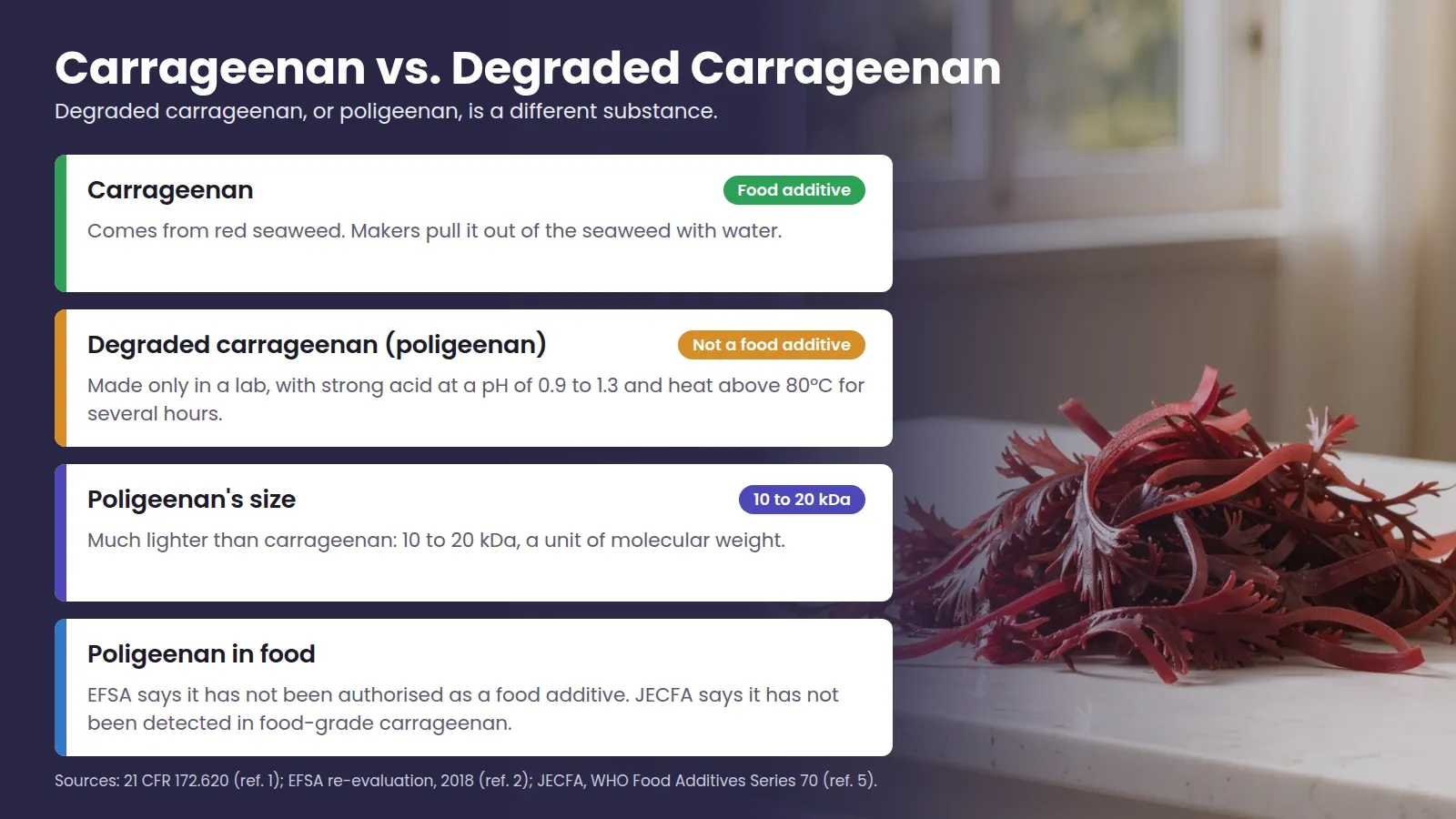
No. Degraded carrageenan is a different substance. JECFA, the WHO and FAO expert committee on food additives, calls it poligeenan [5]. Early papers called it degraded carrageenan [5].
Poligeenan is made only in a lab [5]. Makers treat carrageenan with strong acid, at a pH of 0.9 to 1.3 [2, 5]. They heat it above 80°C for several hours [2, 5]. The result is much lighter, 10 to 20 kDa, a unit of molecular weight [2].
Poligeenan isn't a food additive. EFSA says it has not been authorised as one and isn't used in any food [2]. JECFA says it has not been detected in food-grade carrageenan [5].
The clearest gut-damage findings in animals are about poligeenan. Monkeys given degraded carrageenan showed slight colon erosions at 750 mg per kg a day [2]. At 2,900 mg per kg a day, they showed ulcers with inflammation [2]. JECFA says toxicology studies link poligeenan to gut inflammation and damage [5].
The cancer finding is about poligeenan too. EFSA's opinion reports what IARC found [2]. IARC saw sufficient evidence that degraded carrageenan causes cancer in rats [2]. It placed degraded carrageenan in category 2B, with no human data [2].
Carrageenan itself went in group 3 [2]. IARC found no evidence it causes cancer in animals, and had no human data [2].
Food-grade carrageenan did better in animals. EFSA says short-term studies found no gut harm in rats, guinea pigs, pigs and monkeys [2].
Still, EFSA flags one gray area. The smallest pieces in carrageenan look like poligeenan in structure and size [2]. For that reason, EFSA links them to potential adverse effects [2].
Old research adds a second problem. JECFA says some studies didn't describe their test material well [5]. Some didn't separate poligeenan from carrageenan at all [5].
What Do FDA, EFSA and JECFA Say About Carrageenan?
FDA's position is the rule itself, 21 CFR 172.620 [1]. The section was last amended in 2016 [1].
EFSA published its re-evaluation of carrageenan on April 26, 2018 [2]. In Europe, the additive goes by E 407 [2]. EFSA found carrageenan was not absorbed intact [2].
Long-term rat studies tested up to 7,500 mg per kg of body weight a day [2]. That was the highest dose, and it caused no harm [2]. EFSA found no concern for cancer [2]. It found no concern for genotoxicity, which means damage to genes [2].
So why is the limit temporary? EFSA kept the group ADI at 75 mg per kg of body weight a day [2]. An ADI is an acceptable daily intake [2]. EFSA called it temporary and asked for better data within 5 years [2].
EFSA listed its gaps [2]. One is the theoretical chance that limited degradation could occur in the body [2]. Another is too little data on carrageenan in people who have inflammatory bowel disease [2]. A third is animal findings of glucose intolerance, whose relevance for people is unclear [2].
EFSA also couldn't conclude on inflammation. It lacked relevant studies using well characterised carrageenan [2].
What does 75 mg per kg mean for you? Say you weigh 150 pounds. By our math, EFSA's limit comes to about 5,100 mg a day [2]. That's about 5.1 g.
EFSA set the limit for Europe, and its European intake estimates ran high. At high intake, they went over the temporary ADI, sometimes by up to about 10-fold [2]. EFSA said the exposure may be overestimated [2]. Still, it said an overrun that size may be a safety concern [2].
What came next? EFSA asked for data on October 10, 2018 [3]. The final deadline was December 31, 2022, and the page is marked "Expired" [3]. The 5-year window ran to 2023 [2].
A NutraDetective search of the EFSA Journal on November 7, 2026, found only one EFSA opinion on carrageenan as a food additive, the 2018 one. The 2022 and 2023 EFSA carrageenan opinions are for feed additives.
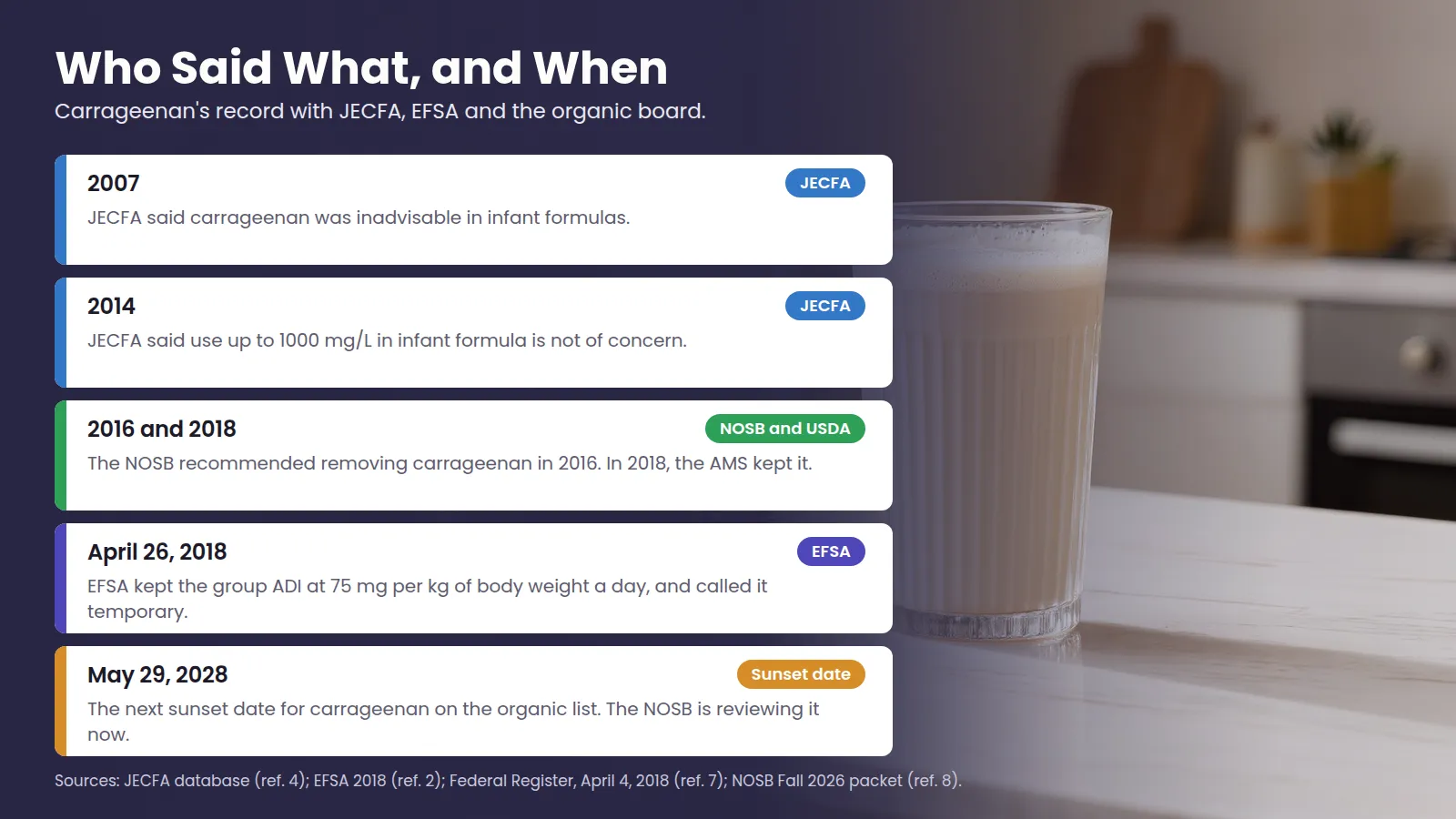
JECFA lists carrageenan's ADI as "NOT SPECIFIED" [4]. Its last evaluation was in 2014, at its 79th meeting [4].
Infant formula is where JECFA changed its view. In 2007, it said carrageenan was inadvisable in infant formulas, based on the information available [4]. In 2014, it said use up to 1000 mg/L is not of concern [4]. That covers infant formula and formula for special medical purposes [4].
JECFA noted that infants who need the higher-level formulas would normally be under medical care [4].
New pig studies changed JECFA's view [5]. JECFA cites a study in newborn pigs [5]. Its NOAEL was 430 mg per kg a day, the highest dose tested [5]. A NOAEL is the no-observed-adverse-effect level, the highest dose with no harm seen [5].
The pigs showed no gut inflammation and no immune effects [5]. JECFA said the new studies allay the earlier concerns about the immature gut [5].
One note on the data. The key pig and minipig studies came from a dossier, a file of studies [5]. FMC Corporation and the International Formula Council prepared it [5].
Can Carrageenan Be in Organic Food?
Yes. Carrageenan is item (9) under 7 CFR 205.605(a) [6]. That section lists nonsynthetic, nonorganic substances allowed in foods labeled organic [6].
No restriction is written next to carrageenan [6]. So it's a nonorganic ingredient allowed in organic products, not organic carrageenan.
The list has a sunset rule. Each substance gets a new review every five years, or it drops off [7]. The NOSB, the National Organic Standards Board, does the review [7]. The AMS is the USDA agency that runs the organic program [7].
The board recommended removing carrageenan in 2016 [8]. It said alternatives such as gellan gum, guar gum or xanthan gum were available [7]. In 2018, the AMS kept carrageenan anyway, with 16 other substances [7]. It cited public comments that wholly natural substitutes weren't available [7].
The 2018 renewal set a sunset date of May 29, 2023 [7]. In 2021, the NOSB voted against removal [8]. The 2023 renewal set the next sunset date, May 29, 2028 [8].
Now carrageenan is under review again. On August 18, 2026, the NOSB Handling Subcommittee voted on removing it [9]. The vote was 1 yes and 3 no [9].
The notes come with a warning [9]. They say they don't represent official NOP policy or NOSB recommendations [9].
The full board met virtually October 27 to 29, 2026 [9]. Carrageenan was on the October 28 agenda under 2028 Handling Sunset Reviews [9]. No outcome was posted when we checked on November 7, 2026 [9].
The Fall 2026 packet raises one more question. It says all or nearly all commercial carrageenan is made through alkaline extraction [8]. Alkaline means the process uses a base, not an acid. The packet says that raises the question of whether carrageenan should count as synthetic [8].
What Are the Side Effects of Carrageenan? What the Human Studies Found
The human studies we read are small, or they show links, not causes. Here's each one, with its size and its limits.
Ulcerative colitis. A 2017 trial studied people with ulcerative colitis in remission, meaning the disease was quiet [11]. It was randomized, double-blind and placebo-controlled [11]. Everyone followed a no-carrageenan diet [11]. Then each person took capsules with carrageenan or with placebo [11].
The carrageenan dose was less than average daily intake from food [11]. Twelve patients completed the questionnaires [11]. Three on carrageenan relapsed, and none on placebo did (p = 0.046) [11].
The authors concluded that carrageenan contributed to earlier relapse in these patients [11]. They said limiting dietary carrageenan may benefit people with ulcerative colitis [11]. Industry critiqued the study, and the authors published an invited reply in 2019 [11]. The trial was small, and everyone in it already had ulcerative colitis [11].
The NOSB packet sums up the evidence [8]. It calls the evidence on food-grade carrageenan and health mixed, and in several areas limited [8]. It says toxicology data find no safety concerns at typical food levels [8].
The packet calls the evidence on gut inflammation conflicting [8]. It adds one more note [8]. Limited human data suggest people who already have inflammatory bowel disease may be more susceptible [8].
Insulin. A 2024 cross-over trial gave 20 men carrageenan or placebo, each in turn [12]. Their mean age was 27.4, and their mean BMI was 24.5 [12]. They took 250 mg morning and evening, 500 mg a day, for 2 weeks each [12].
Overall insulin sensitivity didn't differ between carrageenan and placebo [12]. Insulin sensitivity is how well the body responds to insulin.
The overweight participants were different [12]. In them, carrageenan was linked to lower insulin sensitivity in the body and the liver [12]. It was also linked to higher CRP and IL-6, two blood markers of inflammation [12]. And it was linked to increased intestinal permeability, meaning more passes through the gut wall [12].
The authors wrote that carrageenan may contribute to insulin resistance in overweight people [12]. They also pointed to subclinical inflammation, which is too mild to cause symptoms [12]. The pathway they suggest runs through the gut [12].
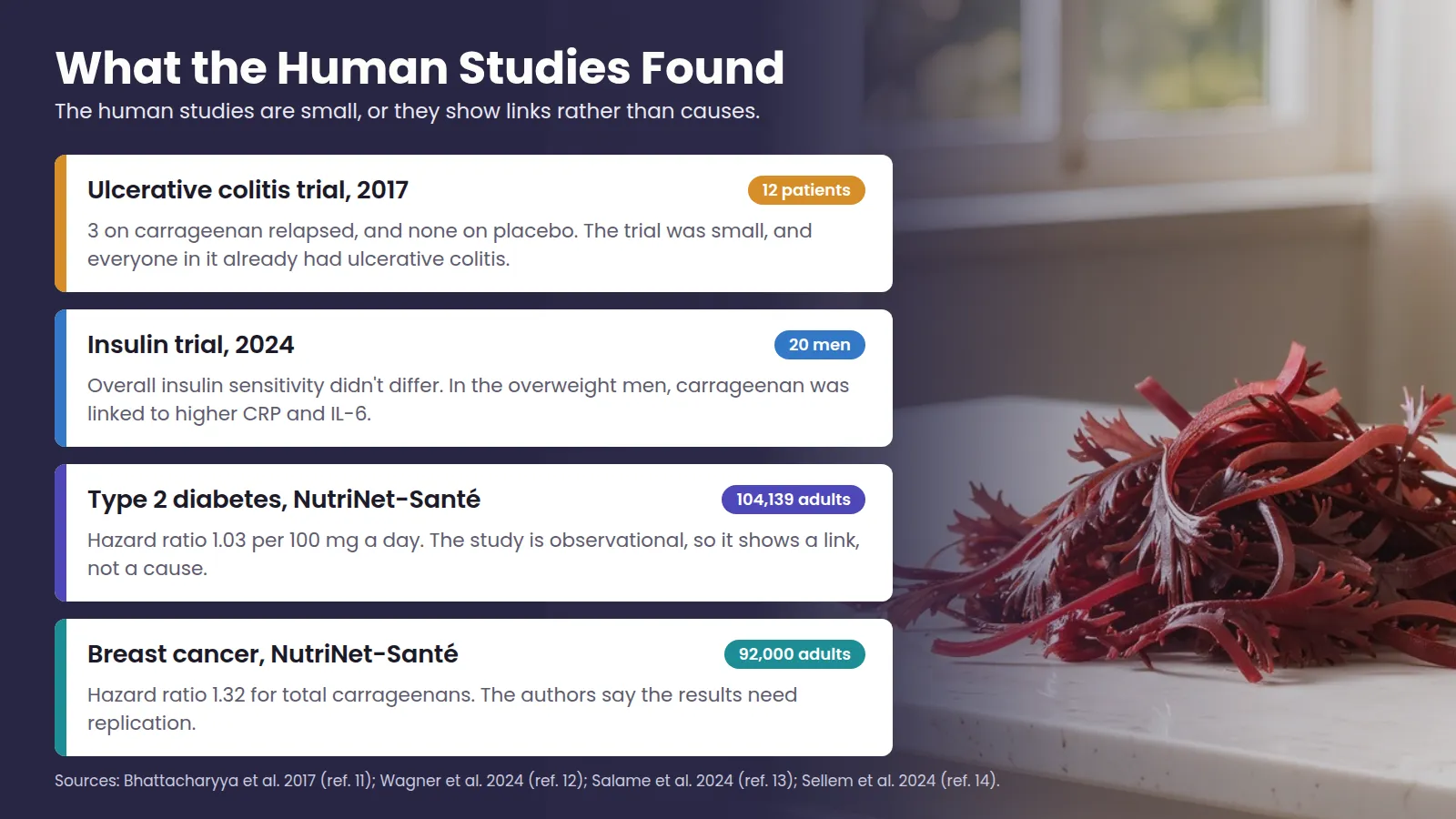
Diabetes. The French NutriNet-Santé cohort followed 104,139 adults for a mean of 6.8 years [13]. Most, 79.2 percent, were women [13]. During follow-up, 1,056 were diagnosed with type 2 diabetes [13].
Total carrageenans were linked to type 2 diabetes [13]. The hazard ratio was 1.03 per 100 mg a day [13]. By our math, that's 3 percent higher relative risk per extra 100 mg a day [13]. That's a risk in this group, not a personal risk.
Guar gum, gum arabic and xanthan gum were linked too [13]. The study is observational, so it shows a link, not a cause [13]. Observational means researchers tracked what people ate and who got sick.
Breast cancer. The same cohort followed 92,000 adults without prior cancer for an average of 6.7 years [14]. Higher intake of total carrageenans was linked to breast cancer [14]. The hazard ratio was 1.32 [14].
Carrageenan E407 alone had a hazard ratio of 1.28 [14]. No emulsifier was linked to colorectal cancer [14]. The authors say the results need replication in other populations [14].
The authors name two main limits [14]. One is possible error in measuring emulsifier intake [14]. The other is residual confounding from the observational design [14]. Confounding means other factors could explain the link.
How to Spot Carrageenan on a Label
We read five store listings on November 7, 2026. Four list carrageenan, and one says it's carrageenan free. Here are the ingredient lines as the stores print them.
- Hood Golden Egg Nog (Stop & Shop): "Milk, Cream, Sugar, High Fructose Corn Syrup, Egg Yolks, Nonfat Milk, Natural & Artificial Flavors, Guar Gum, Salt, Spice, Annatto & Turmeric Extracts (Color), Carrageenan, Mono & Diglycerides." [15]
- Stop & Shop Non-Dairy Original Coffee Creamer: "Water, Corn Syrup, Vegetable Oil (Soybean And/or Palm), Sodium Caseinate (a Milk Derivative), Dipotassium Phosphate, DATEM, Carrageenan." The listing also says "This is a non-dairy product." and "Contains: milk." [16]
- Oscar Mayer Deli Fresh Honey Smoked Turkey Breast Sliced (Stop & Shop): "Turkey Breast, Water, Honey, Contains Less Than 2% Of Vinegar, Modified Cornstarch, Salt, Cultured Dextrose*, Sugar, Sodium Phosphates, Carrageenan. * Ingredients To Support Quality." [17]
- Hillshire Farm Oven Roasted Turkey Breast Ultra Thin Sliced (Hannaford): "Turkey Breast, Turkey Broth, Modified Corn Starch, Vinegar*, Contains 2% Or Less: Carrageenan, Citric Acid, Cultured Dextrose*, Natural Flavor, Salt, Sodium Phosphates, * To Preserve Quality." [18]
- Califia Farms Unsweetened Vanilla Almondmilk (Hannaford): "Almondmilk (Water, Almonds), Natural Vanilla Flavors With Other Natural Flavor, Calcium Carbonate, Sunflower Lecithin, Sea Salt, Guar Gum, Gellan Gum, Vitamin A Palmitate, Vitamin D2, Potassium Citrate." The listing says "Carrageenan free." [19]
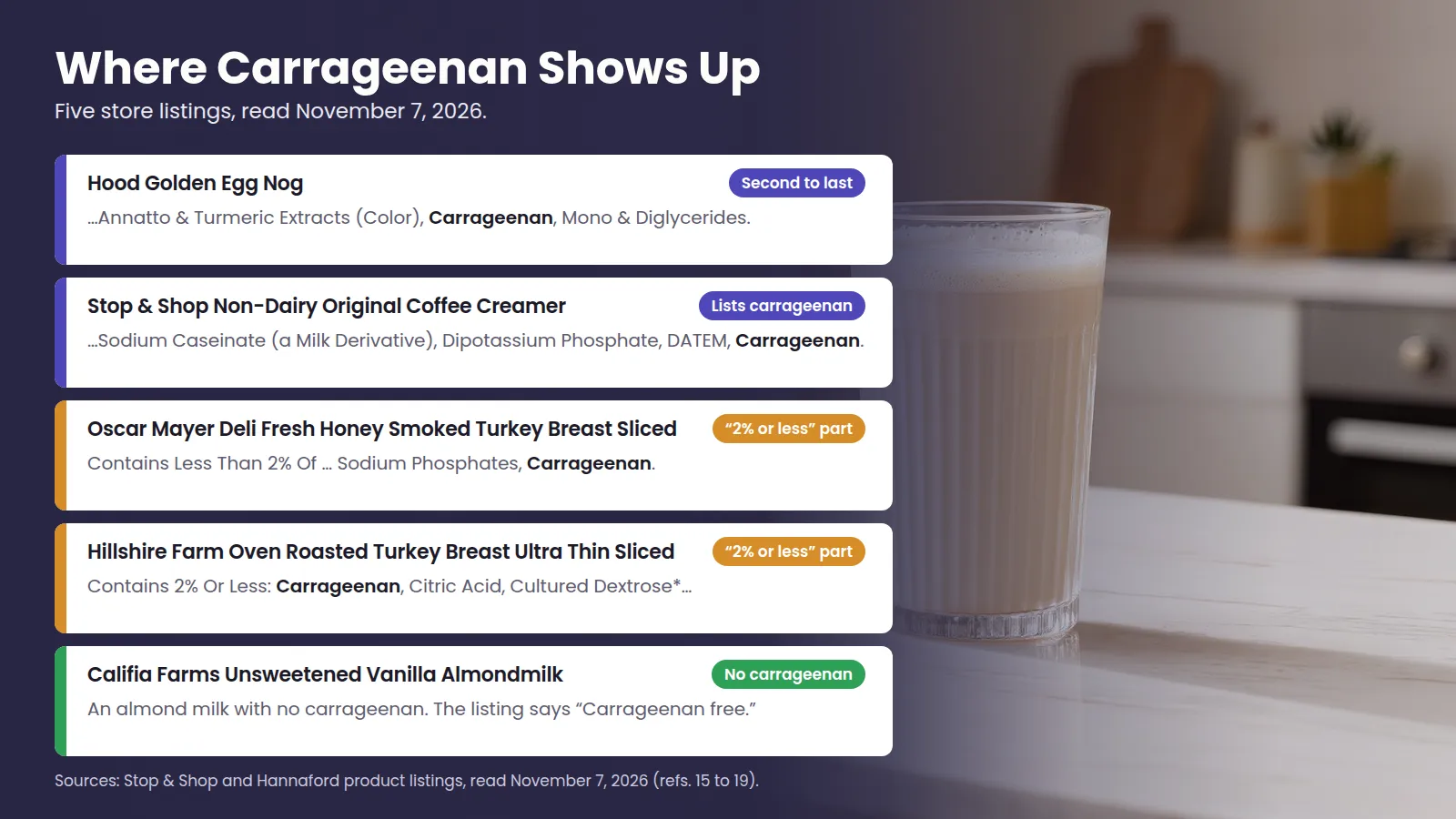
- Find the word carrageenan. Read the whole list. In Hood Golden Egg Nog, carrageenan is second to last [15].
- Check the "2% or less" part. In both turkey labels, carrageenan sits in the "Contains Less Than 2% Of" or "Contains 2% Or Less" part [17, 18].
- Read the whole list on "non-dairy" products. Stop & Shop Non-Dairy Original Coffee Creamer says "This is a non-dairy product." It also lists Sodium Caseinate (a Milk Derivative) and says "Contains: milk." [16]
- Know what "carrageenan free" means. Califia Farms Unsweetened Vanilla Almondmilk says "Carrageenan free." Its list has guar gum and gellan gum [19]. The USDA organic board named gellan gum and guar gum as alternatives to carrageenan [7].
- Scan the package. Scan it with the free NutraDetective app to see the additives in it.
Three of the four eggnogs in our eggnog ingredients check list carrageenan. Carrageenan is number 8 in our harmful food additives guide. Polysorbate 80 is another emulsifier we checked. Thickeners and emulsifiers are marker ingredients in our ultra-processed foods guide.
Frequently Asked Questions
A. The rules say no. FDA's rule says carrageenan "may be safely used in food." EFSA found no cancer concern in 2018, but calls its daily limit temporary because of data gaps. The human studies are small, or they show links rather than causes.
A. No. Carrageenan is allowed in Europe as E 407. EFSA re-evaluated it in 2018. It kept a temporary daily limit of 75 mg per kg of body weight.
A. No, poligeenan is a different substance, also called degraded carrageenan. It's made only in a lab, with strong acid and heat above 80°C. EFSA says it isn't authorised as a food additive. JECFA says it hasn't been detected in food-grade carrageenan.
A. The NOSB packet calls the evidence on gut inflammation conflicting. EFSA couldn't conclude, for lack of good studies. In a small ulcerative colitis trial, 3 people on carrageenan relapsed and none on placebo did. In a 20-man trial, the overweight men showed higher inflammation markers.
A. Yes. Carrageenan is allowed as a nonorganic ingredient under 7 CFR 205.605(a)(9). Its sunset date is May 29, 2028, and the NOSB is reviewing it now. The subcommittee voted 1 to 3 against removing it in August 2026.
A. In 2007, JECFA said carrageenan was inadvisable in infant formulas. In 2014, it said use up to 1000 mg/L is not of concern. A dossier by FMC Corporation and the International Formula Council supplied the pig studies. The NOSB packet, citing Zhang et al. 2024a, says China restricts the amount allowed in baby formula.
A. We found it in Hood Golden Egg Nog, Stop & Shop Non-Dairy Original Coffee Creamer, and two deli turkeys. They are Oscar Mayer Deli Fresh Honey Smoked Turkey Breast Sliced and Hillshire Farm Oven Roasted Turkey Breast Ultra Thin Sliced. In both turkey labels, it sat in the "2% or less" part.
References
- Code of Federal Regulations. 21 CFR 172.620, Carrageenan. eCFR, current text (section last amended November 22, 2016). https://www.ecfr.gov/current/title-21/chapter-I/subchapter-B/part-172/subpart-G/section-172.620
- EFSA Panel on Food Additives and Nutrient Sources added to Food (ANS). Re-evaluation of carrageenan (E 407) and processed Eucheuma seaweed (E 407a) as food additives. EFSA Journal. 2018;16(4):e05238. April 26, 2018. doi:10.2903/j.efsa.2018.5238. PMID 32625873. https://doi.org/10.2903/j.efsa.2018.5238
- European Food Safety Authority. Call for technical and toxicological data on carrageenan (E 407) for uses in foods for all population groups including infants below 16 weeks of age. Published October 10, 2018. EFSA-Q-2018-00771. https://www.efsa.europa.eu/en/consultations/call/call-technical-and-toxicological-data-carrageenan-e-407-uses-foods
- World Health Organization. JECFA database: Carrageenan (INS 407). Evaluation year 2014, 79th meeting. https://apps.who.int/food-additives-contaminants-jecfa-database/Home/Chemical/377
- World Health Organization. Safety Evaluation of Certain Food Additives. WHO Food Additives Series 70. 79th meeting of JECFA. Geneva, 2015. Carrageenan monograph. https://inchem.org/documents/jecfa/jecmono/v70je01.pdf
- Code of Federal Regulations. 7 CFR 205.605, Nonagricultural (nonorganic) substances allowed as ingredients in or on processed products labeled as "organic" or "made with organic." eCFR, current text (latest amendment March 21, 2025). https://www.ecfr.gov/current/title-7/section-205.605
- U.S. Department of Agriculture, Agricultural Marketing Service. National Organic Program: USDA Organic Regulations, Notification of 2018 Sunset Review. Federal Register 83 FR 14347-14348. April 4, 2018. FR Doc. 2018-06867. https://www.govinfo.gov/content/pkg/FR-2018-04-04/html/2018-06867.htm
- USDA Agricultural Marketing Service, National Organic Program. National Organic Standards Board Proposals and Discussion Documents, Fall 2026 (meeting packet), pp. 57-61, Carrageenan. https://www.ams.usda.gov/sites/default/files/media/NOSBMeetingPacketFall2026.pdf
- USDA Agricultural Marketing Service. NOSB Handling Subcommittee Notes, August 18, 2026 (https://www.ams.usda.gov/sites/default/files/media/HSNotes.pdf); NOSB Meeting - Virtual, Fall 2026, event page (https://www.ams.usda.gov/event/national-organic-standards-board-nosbboard-meeting-virtual); and NOSB Fall 2026 meeting agenda, AgendaNOSBFall2026VirtualExternal.pdf, linked from the event page.
- U.S. Food and Drug Administration. List of Select Chemicals in the Food Supply Under FDA Review. Content current as of October 29, 2026. https://www.fda.gov/food/food-chemical-safety/list-select-chemicals-food-supply-under-fda-review
- Bhattacharyya S, Shumard T, Xie H, et al. A randomized trial of the effects of the no-carrageenan diet on ulcerative colitis disease activity. Nutrition and Healthy Aging. 2017;4(2):181-192. doi:10.3233/nha-170023. PMID 28447072. https://doi.org/10.3233/nha-170023. And: Bhattacharyya S, et al. Reply to critique. Nutrition and Healthy Aging. 2019;5(2):159-163. PMID 31922053.
- Wagner R, Buettner J, Heni M, et al. Carrageenan and insulin resistance in humans: a randomised double-blind cross-over trial. BMC Medicine. 2024;22(1):558. doi:10.1186/s12916-024-03771-8. PMID 39593091. https://doi.org/10.1186/s12916-024-03771-8
- Salame C, Javaux G, Sellem L, et al. Food additive emulsifiers and the risk of type 2 diabetes: analysis of data from the NutriNet-Santé prospective cohort study. Lancet Diabetes & Endocrinology. 2024;12(5):339-349. doi:10.1016/s2213-8587(24)00086-x. PMID 38663950. https://doi.org/10.1016/s2213-8587(24)00086-x
- Sellem L, Srour B, Javaux G, et al. Food additive emulsifiers and cancer risk: Results from the French prospective NutriNet-Santé cohort. PLoS Medicine. 2024;21(2):e1004338. doi:10.1371/journal.pmed.1004338. PMID 38349899. https://doi.org/10.1371/journal.pmed.1004338
- Stop & Shop. Hood Golden Egg Nog, 1 quart (product listing). Read November 7, 2026. https://stopandshop.com/groceries/product/hood-golden-egg-nog-1-quart/220558
- Stop & Shop. Stop & Shop Non-Dairy Original Coffee Creamer, 32 oz (product listing). Read November 7, 2026. https://stopandshop.com/groceries/product/stop-shop-non-dairy-original-coffee-creamer-32-oz-btl/401228
- Stop & Shop. Oscar Mayer Deli Fresh Honey Smoked Turkey Breast Sliced, 9 oz (product listing). Read November 7, 2026. https://stopandshop.com/groceries/deli-prepared-food/packaged-lunch-meat/oscar-mayer-deli-fresh-honey-smoked-turkey-breast-sliced-9-oz-pkg.html
- Hannaford. Hillshire Farm Oven Roasted Turkey Breast Ultra Thin Sliced Mega Pack, 22 oz (product listing). Read November 7, 2026. https://hannaford.com/groceries/deli-prepared-food/packaged-lunch-meat/packaged-lunch-meat-turkey/hillshire-farm-oven-roasted-turkey-breast-ultra-thin-sliced-mega-pack-22-oz-pkg.html
- Hannaford. Califia Farms Unsweetened Vanilla Almondmilk, 48 oz (product listing). Read November 7, 2026. https://hannaford.com/groceries/dairy-eggs/milk/plant-based-milk/almondmilk/califia-farms-unsweetened-vanilla-almondmilk-48-oz-btl.html