Fact-checked November 2026.
Maltodextrin is made from starch that has been partly broken down into chains of glucose [1]. FDA lists it as GRAS, "generally recognized as safe" [1]. Its only limit is good manufacturing practice [1]. Good manufacturing practice means the maltodextrin must be food grade, and makers can add only the amount needed to do its job [17].
So is maltodextrin bad for you? By the rule, no.
Two things are worth knowing anyway. A 2016 review says its glucose is rapidly absorbed [4]. Swapping unprocessed starch for it may raise blood sugar after meals [4].
Mouse studies link it to a thinner gut mucus layer [8, 9]. No human trial in our search tested that.
We read the federal rule, the gluten-free rule, FDA's allergen guidance and FDA's fiber page. We also read one review, one meta-analysis, five gut studies and five store product pages.
What Is Maltodextrin?
Maltodextrin starts as starch from corn, potato or rice [1]. According to the federal rule 21 CFR 184.1444, makers break the starch down partway with safe and suitable acids and enzymes [1]. That step is called hydrolysis, which means breaking bonds with water.
The result is a white powder or concentrated solution [1].
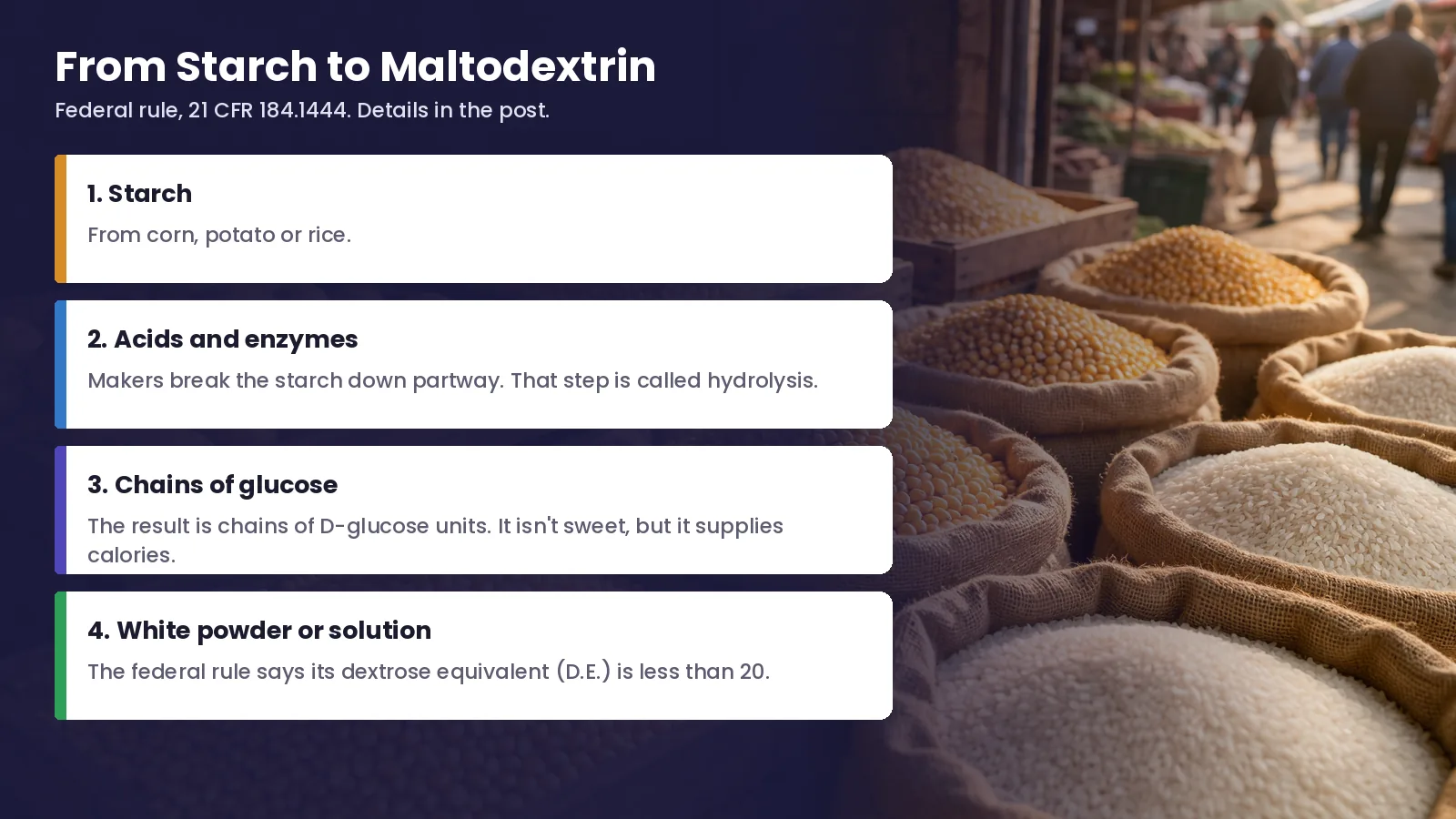
The rule calls maltodextrin a nonsweet nutritive saccharide polymer [1]. In plain words, that's a chain of sugar units. It isn't sweet, but it does supply calories. The units are D-glucose, linked mostly by α-1-4 bonds [1].
How far is the starch broken down? The federal rule says maltodextrin's dextrose equivalent, or D.E., is less than 20 [1]. D.E. is a number that shows how far the starch has been broken down [4].
The 2016 review gives D.E. as the amount of reducing sugars relative to total carbohydrate [4]. For digestible maltodextrins, that's between 3 and 20 percent [4].
Maltodextrin sits in Part 184 of the federal code [1]. That's the list of substances affirmed as GRAS, "generally recognized as safe" [1]. The rule's only limit is current good manufacturing practice [1]. The FDA rule dates from 1983, with amendments through March 2023 [1].
Does Maltodextrin Raise Blood Sugar?
It may. The 2016 review is by Hofman, van Buul and Brouns [4]. It says glucose from digested maltodextrins is rapidly absorbed in the small intestine [4]. The authors say that rising use has raised questions about effects on metabolism and health [4].
Maltodextrin is made from starch that has already been partly broken down [1]. The review also says that exchanging unprocessed starch for maltodextrins may lead to a higher glycemic load [4]. A higher glycemic load may mean higher post-meal glycaemia [4].
Glycemic load measures how much a serving raises blood sugar. Post-meal glycaemia is blood sugar after eating.
A food made with maltodextrin instead of unprocessed starch may raise blood sugar more after you eat [4].
The review calls those changes less desirable for health [4]. It uses "may," so we do too. The review is a summary of other studies, not a new experiment [4]. It gives no glycemic index number for maltodextrin [4].
What Are the Side Effects of Maltodextrin?
No official source we read lists side effects for maltodextrin. The official sources we read are the federal rule, FDA's allergen guidance, the gluten-free rule and FDA's fiber page [1, 2, 3, 5]. So here's what the research does and doesn't show, sorted by what was studied.
Say you search "maltodextrin side effects" and find a list of gut problems. Every gut study we read is a lab or mouse study [7, 8, 9, 10, 11]. We found no human trial of maltodextrin and gut inflammation.
In lab dishes. A 2012 study by Nickerson and McDonald was done in dishes [7]. It used bacteria and human intestinal cell layers [7]. No people ate maltodextrin, and no animals were used [7].
Maltodextrin markedly increased biofilm formation by LF82 [7]. LF82 is an E. coli strain linked to Crohn's disease [7]. A biofilm is a sticky layer of bacteria. The researchers added maltodextrin to LF82 bacteria in a dish [7]. The E. coli bacteria then made more biofilm [7].
In the same study, maltodextrin also increased the E. coli's sticking to human intestinal cell layers [7]. The authors suggest a new mechanism for that [7]. They also looked for malX, a gene the bacteria need to use maltodextrin [7]. MalX showed up more often in the ileum of Crohn's disease patients [7].
A 2024 study used a lab gut model [11]. The gut bacteria came from healthy donors and donors with IBD, inflammatory bowel disease [11]. No people ate the additives [11].
The result was mixed [11]. Maltodextrin increased short-chain fatty acids, compounds gut bacteria make from carbohydrates [11].
But maltodextrin also changed which gut bacteria grew [11]. It helped a group called Ruminococcus grow, and the authors link that group to a higher risk of fibrosis [11]. Fibrosis is scarring. It also cut back a group called Oscillospira, which is linked to less fibrosis [11].
In mice. A 2014 study gave mice water with maltodextrin added [8]. Those mice had a breakdown of the gut's mucous layer [8]. The mucous layer keeps gut bacteria off the intestinal surface [8].
After being given Salmonella by mouth, the mice that drank maltodextrin had more bacteria in the cecum [8]. The cecum is part of the gut.

A 2019 study by Laudisi and colleagues used three additives [9]. Mice got water with maltodextrin, propylene glycol or animal gelatin [9]. Then the mice got chemicals that provoke gut injury [9].
Maltodextrin, but not the other two, made the inflammation worse in both models [9]. Maltodextrin was not shown to cause colitis, inflammation of the colon, on its own [9]. The gut injury came from the chemicals [9].
The authors report that maltodextrin raises ER stress in gut lining cells [9]. ER stress is strain inside a cell's protein-making machinery. That lowered mucus production and mucin-2, the main protein in gut mucus [9]. The bacteria on the gut lining didn't change significantly [9].
A 2022 study used mice bred to be prone to colitis [10]. They ate diets with maltodextrin or carboxymethyl cellulose, CMC [10]. Both increased how often colitis started and how severe it was [10]. Both also lowered microbiome diversity and fecal acetic acid [10].
The authors suggest maltodextrin upsets the balance of gut lining cells [10]. It does so through direct and indirect actions, they say [10]. That's in colitis-prone mice, not people [10].
Is Maltodextrin the Same as Resistant Maltodextrin?
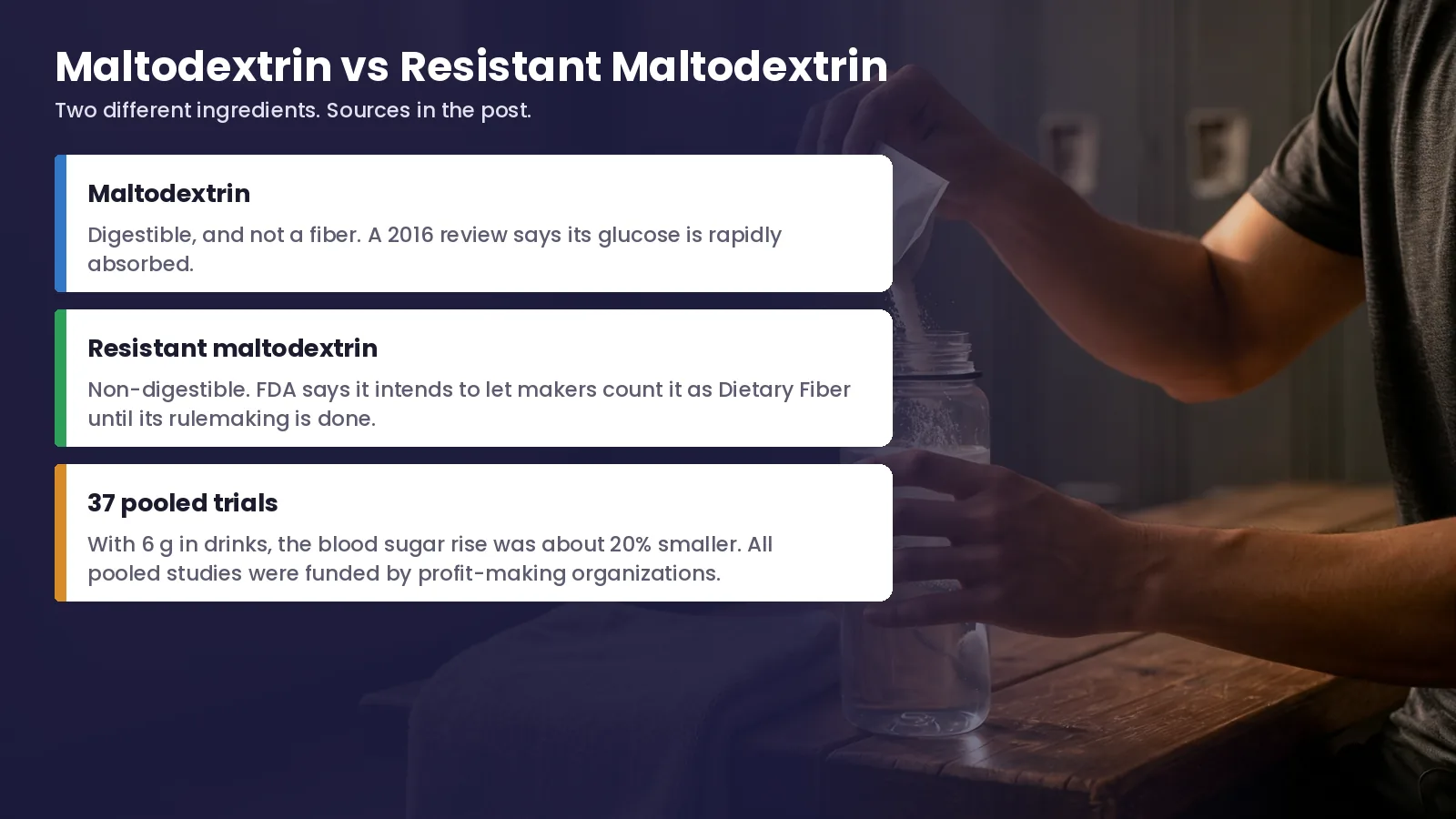
No. Resistant maltodextrin is a different ingredient [5, 6]. Regular maltodextrin is digestible and isn't a fiber [1, 4, 5]. Resistant maltodextrin is non-digestible [5]. Non-digestible means the small intestine doesn't break it down.
To count as fiber, an added non-digestible carbohydrate like resistant maltodextrin also needs FDA to find that it has a health benefit [5]. FDA's Nutrition Facts rule defines dietary fiber in part [5]. Fiber means non-digestible carbohydrates with 3 or more units [5].
FDA says it intends to propose adding certain non-digestible carbohydrates to the definition [5]. The list includes resistant maltodextrin/dextrin [5].
Until FDA completes its rulemaking on these fibers, FDA says it intends to let makers include resistant maltodextrin and the other listed fibers in the Dietary Fiber amount on the label [5]. FDA's fiber page says that in June 2018, FDA granted many petitions asking it to consider adding certain non-digestible carbohydrates to the fiber definition [5].
Of the studies we read, only the resistant maltodextrin meta-analysis was done in people [6]. A 2009 meta-analysis by Livesey and Tagami pooled 37 trials [6]. The trials were in healthy adults [6]. The researchers gathered trials up to April 2007 [6]. The meta-analysis looked at 10 g or less of resistant maltodextrin [6].
In the trials, people ate starchy foods with resistant maltodextrin added in a drink or in the food itself [6]. With 6 g of resistant maltodextrin in drinks, the blood sugar rise from starchy foods was about 20 percent smaller [6]. In foods, the rise was about 10 percent smaller [6]. Both results were significant, and the evidence was stronger in drinks [6].
One note on the data. One author worked for Matsutani Chemical Industry [6]. The authors say all the pooled studies were funded by profit-making organizations [6]. The meta-analysis tested resistant maltodextrin only, not regular maltodextrin [6].
Does Maltodextrin Have Gluten or Wheat?
Maltodextrin can contain wheat protein if it's made from wheat [4].
The federal rule names corn, potato and rice starch only [1]. It doesn't name wheat or tapioca [1]. The 2016 review says other starches can be used in the U.S. [4]. The company must self-determine GRAS, and the product must have the same structure [4].
So can wheat be in it? Yes, and then the label rules apply. FDA's allergen guidance lists wheat among the nine major food allergens [2]. An ingredient counts as an allergen when it contains protein from one of those nine foods [2].
An ingredient made from wheat with no wheat protein left isn't subject to allergen labeling [2]. The guidance doesn't name maltodextrin [2].
The 2016 review applies the rule [4]. If a maltodextrin contains wheat protein, the word "wheat" must appear [4]. Its example puts "(wheat)" after the ingredient name [4].
Say you avoid wheat and you're reading a meat, poultry or egg label. The 2016 review says those labels only need the ingredient's common or usual name [4]. So "maltodextrin" alone may appear even with wheat protein [4]. The review says FSIS, the Food Safety and Inspection Service, encourages allergen statements anyway [4].
What about "gluten-free"? The rule is 21 CFR 101.91 [3]. It allows an ingredient made from a gluten grain and processed to remove gluten [3]. Its example is wheat starch, not maltodextrin [3].
A food labeled gluten-free must stay below 20 parts per million (ppm) of gluten [3]. The rule states that 20 ppm is 20 milligrams of gluten per kilogram of food [3]. No source we read gives a gluten level for wheat maltodextrin.
How to Spot Maltodextrin on a Label
Look for the word maltodextrin in the ingredient list. Some labels also name its source, such as "Corn Maltodextrin" on Lay's Sour Cream & Onion chips [16].
We read five H-E-B product pages on November 7, 2026. Here are the ingredient lines as the store prints them.
- Gatorade Zero Sugar Orange Thirst Quencher Powder Packets: "Citric Acid, Sodium Citrate, Salt, Monopotassium Phosphate, Modified Food Starch, Maltodextrin, Sucralose, Natural Flavor, Silicon Dioxide, Acesulfame Potassium, Yellow 6, Tocopherols (to Protect Flavor)." [12]
- Gatorade Thirst Quencher Powder Lemon-Lime: "Sugar, Dextrose, Citric Acid, Natural and Artificial Flavor, Salt, Sodium Citrate, Monopotassium Phosphate, Calcium Silicate, Modified Food Starch, Yellow 5." [13]
- Splenda Zero Calorie Sweetener Packets: the H-E-B page lists dextrose, maltodextrin and sucralose, in that order [14].
- Hidden Valley Original Ranch Salad Dressing and Seasoning Mix Packet: "Maltodextrin, Buttermilk, Salt, Monosodium Glutamate, Garlic (2), Onion (2), Lactic Acid, Calcium Lactate, Spices, Citric Acid, Less Than 1% Of: Calcium Stearate, Artificial Flavor, Xanthan Gum, Carboxymethylcellulose, Guar Gum, Natural Flavor. (2) Dried." The allergen line: "Contains: Milk, Soy." [15]
- Lay's Sour Cream & Onion Flavored Potato Chips: "Potatoes, Vegetable Oil (Canola, Corn, Soybean, And/Or Sunflower Oil), Skim Milk, Salt, Whey, Onion Powder, Parsley, Sour Cream (Cultured Cream, Skim Milk), Dextrose, Corn Maltodextrin, Natural Flavors, Medium Chain Triglycerides, Lactose, And Citric Acid. CONTAINS MILK INGREDIENTS." The allergen line: "Contains: MILK." [16]
How to Check Your Own Labels for Maltodextrin
- Read the whole list, even on "zero sugar." Gatorade Zero Sugar Orange lists maltodextrin sixth [12].
- Check the first ingredient. In Hidden Valley Original Ranch mix, maltodextrin comes first [15]. The page doesn't say what the maltodextrin is made from [15].
- Look for a named source. Lay's Sour Cream & Onion lists "Corn Maltodextrin" [16].
- Scan the package. Scan it with the free NutraDetective app to see the additives in it.
We've found maltodextrin in other foods too. It was on a Stove Top label in our stuffing mix check and in a store-brand cocoa in our hot cocoa mix check. It's also one of the sugar markers in our ultra-processed foods definition guide.
The Hidden Valley packet also lists monosodium glutamate, which our MSG post covers. Our polysorbate 80 post covers the rule that ingredients are listed by weight. For more additives, see our harmful food additives guide.
Frequently Asked Questions
A. By the rule, no. FDA lists it as GRAS with no limit beyond good manufacturing practice. A 2016 review says swapping unprocessed starch for maltodextrin may raise post-meal blood sugar. The gut studies are in lab dishes and mice, not people.
A. The federal rule names corn, potato or rice starch. Makers break the starch down partway with acids and enzymes. The result is a white powder or concentrated solution. A 2016 review says other starches can be used if the company self-determines GRAS.
A. It may. A 2016 review says glucose from digested maltodextrin is rapidly absorbed in the small intestine. Swapping unprocessed starch for maltodextrin may raise glycemic load and post-meal blood sugar. The review gives no glycemic index number.
A. It depends on the starch. The federal rule names corn, potato and rice, not wheat. On FDA-regulated foods, if a maltodextrin contains wheat protein, "wheat" must appear on the label. The gluten-free rule allows wheat ingredients processed to remove gluten if the food stays below 20 ppm gluten.
A. No. Regular maltodextrin is digested and its glucose is rapidly absorbed. Resistant maltodextrin is non-digestible, and FDA intends to propose adding it to the dietary fiber definition. In 37 pooled trials, 6 g in drinks cut the rise by about 20 percent.
A. No human trial in our search tested that. In mice, maltodextrin thinned the gut mucus layer and made induced colitis worse. In lab dishes, it helped a Crohn's-linked E. coli strain form biofilm. None of these studies shows an effect in people.
A. We found it in Gatorade Zero Sugar Orange powder packets and Splenda Zero Calorie Sweetener Packets. It's also in Hidden Valley Original Ranch seasoning mix and Lay's Sour Cream & Onion chips. The regular Gatorade Lemon-Lime powder doesn't list it. Read each label.
References
- Code of Federal Regulations. 21 CFR 184.1444, Maltodextrin. eCFR, current text (version dated through November 1, 2026). https://www.ecfr.gov/current/title-21/chapter-I/subchapter-B/part-184/subpart-B/section-184.1444
- U.S. Food and Drug Administration, Human Foods Program. Questions and Answers Regarding Food Allergens, Including the Food Allergen Labeling Requirements of the Federal Food, Drug, and Cosmetic Act (Edition 5): Guidance for Industry. January 2025. https://www.fda.gov/media/117410/download
- Code of Federal Regulations. 21 CFR 101.91, Gluten-free labeling of food. eCFR, current text (version dated through November 1, 2026). https://www.ecfr.gov/current/title-21/chapter-I/subchapter-B/part-101/subpart-F/section-101.91
- Hofman DL, van Buul VJ, Brouns FJ. Nutrition, Health, and Regulatory Aspects of Digestible Maltodextrins. Critical Reviews in Food Science and Nutrition. 2016;56(12):2091-2100. PMID 25674937. PMCID PMC4940893. https://doi.org/10.1080/10408398.2014.940415. https://pubmed.ncbi.nlm.nih.gov/25674937/
- U.S. Food and Drug Administration. Questions and Answers on Dietary Fiber. Content current as of July 25, 2024. https://www.fda.gov/food/nutrition-food-labeling-and-critical-foods/questions-and-answers-dietary-fiber
- Livesey G, Tagami H. Interventions to lower the glycemic response to carbohydrate foods with a low-viscosity fiber (resistant maltodextrin): meta-analysis of randomized controlled trials. American Journal of Clinical Nutrition. 2009;89(1):114-125. PMID 19126874. https://doi.org/10.3945/ajcn.2008.26842. https://pubmed.ncbi.nlm.nih.gov/19126874/
- Nickerson KP, McDonald C. Crohn's disease-associated adherent-invasive Escherichia coli adhesion is enhanced by exposure to the ubiquitous dietary polysaccharide maltodextrin. PLoS One. 2012;7(12):e52132. PMID 23251695. https://doi.org/10.1371/journal.pone.0052132. https://pubmed.ncbi.nlm.nih.gov/23251695/
- Nickerson KP, Homer CR, Kessler SP, et al. The dietary polysaccharide maltodextrin promotes Salmonella survival and mucosal colonization in mice. PLoS One. 2014;9(7):e101789. PMID 25000398. https://doi.org/10.1371/journal.pone.0101789. https://pubmed.ncbi.nlm.nih.gov/25000398/
- Laudisi F, Di Fusco D, Dinallo V, et al. The Food Additive Maltodextrin Promotes Endoplasmic Reticulum Stress-Driven Mucus Depletion and Exacerbates Intestinal Inflammation. Cellular and Molecular Gastroenterology and Hepatology. 2019;7(2):457-473. PMID 30765332. https://doi.org/10.1016/j.jcmgh.2018.09.002. https://pubmed.ncbi.nlm.nih.gov/30765332/
- Zangara MT, Ponti AK, Miller ND, et al. Maltodextrin Consumption Impairs the Intestinal Mucus Barrier and Accelerates Colitis Through Direct Actions on the Epithelium. Frontiers in Immunology. 2022;13:841188. PMID 35359925. https://doi.org/10.3389/fimmu.2022.841188. https://pubmed.ncbi.nlm.nih.gov/35359925/
- Gonza I, Goya-Jorge E, Douny C, et al. Food additives impair gut microbiota from healthy individuals and IBD patients in a colonic in vitro fermentation model. Food Research International. 2024;182:114157. PMID 38519184. https://doi.org/10.1016/j.foodres.2024.114157. https://pubmed.ncbi.nlm.nih.gov/38519184/
- H-E-B. Gatorade Zero Sugar Orange Thirst Quencher Powder Packets, 10 ct (product page). Read November 7, 2026. https://heb.com/product-detail/gatorade-zero-sugar-orange-thirst-quencher-powder-packets-10-ct/4528525
- H-E-B. Gatorade Thirst Quencher Powder Lemon-Lime (product page). Read November 7, 2026. https://heb.com/product-detail/gatorade-thirst-quencher-powder-lemon-lime/1261744
- H-E-B. Splenda Zero Calorie Sweetener Packets (product page). Read November 7, 2026. https://heb.com/product-detail/splenda-zero-calorie-sweetener-packets/256213
- H-E-B. Hidden Valley Original Ranch Salad Dressing and Seasoning Mix Packet (product page). Read November 7, 2026. https://heb.com/product-detail/hidden-valley-original-ranch-salad-dressing-seasoning-mix/163624
- H-E-B. Lay's Sour Cream & Onion Flavored Potato Chips (product page). Read November 7, 2026. https://heb.com/product-detail/lay-s-sour-cream-onion-potato-chips/1865759
- Code of Federal Regulations. 21 CFR 184.1(b), Substances added directly to human food affirmed as generally recognized as safe (GRAS). eCFR, current text (up to date as of October 22, 2026). https://www.ecfr.gov/current/title-21/chapter-I/subchapter-B/part-184/subpart-A/section-184.1