Fact-checked October 2026.
Polysorbate 80 is an emulsifier that keeps oil and water from separating. FDA allows it in a short, specific list of foods, each with its own limit: ice cream and frozen desserts, pickles, whipped toppings, gelatin desserts, shortenings, cottage cheese and barbecue sauce, among others. Regulators in the United States, Europe and at the World Health Organization all treat it as safe at the amounts people eat. A line of mouse and laboratory studies says it may change gut bacteria, and a controlled trial in people, published in 2026, found no difference in inflammation markers.
That is the short answer. The long answer took us through the paper trail.
We opened the full text of the federal rule that governs polysorbate 80 (21 CFR 172.840), the European Food Safety Authority's 2015 re-evaluation, the conclusions of the WHO expert committee that met in June 2026, and five studies that get cited whenever this additive comes up. Here is what the records show, what the research found, and what it did not.
What Is Polysorbate 80?
Polysorbate 80 is the everyday name for polyoxyethylene (20) sorbitan monooleate. It is a food additive regulated by FDA under 21 CFR 172.840, the section of the Code of Federal Regulations that lists where it may be used and how much is allowed [1].
The rule also describes how it is made. Manufacturers react oleic acid (a fatty acid) with sorbitol (a sugar alcohol), then react that product with ethylene oxide [1]. The result is a molecule with one end that likes water and one end that likes oil, which is what lets it hold a mixture together.
In the European Union, the same additive carries the code E 433 [2]. If you have ever seen "E433" on an imported product, that is polysorbate 80.
It belongs to a family. Polysorbates 20, 40, 60, 65 and 80 are all built the same way from different fatty acids, and regulators evaluate them as a group. That matters later, because the safety limits you will read about apply to the whole family, not to polysorbate 80 alone.
If you want the bigger picture on emulsifiers, preservatives and the other additives that show up on labels, start with our overview of food additives.
Which Foods Contain Polysorbate 80?
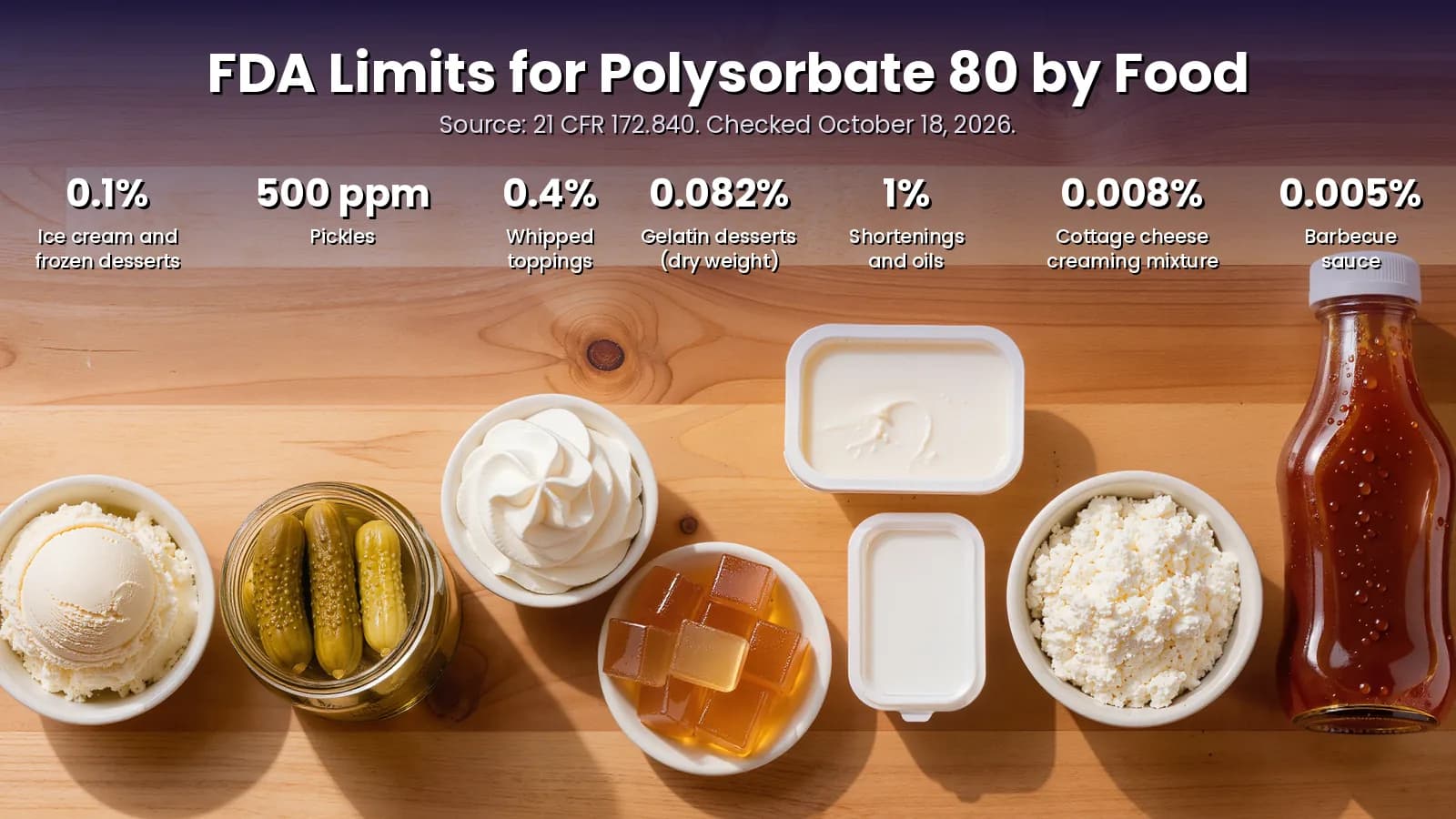
This is where the records are more useful than any list you will find on a forum. FDA does not allow polysorbate 80 in food generally. It allows it in named foods, for named purposes, at set maximums. We went through every paragraph of the rule and pulled out each one [1].
| Food | What it does there | FDA limit |
|---|---|---|
| Ice cream, frozen custard, ice milk, fruit sherbet and nonstandardized frozen desserts | Emulsifier | No more than 0.1% of the finished dessert, alone or combined with polysorbate 65 |
| Pickles and pickle products | Solubilizing and dispersing agent | No more than 500 parts per million |
| Whipped edible oil toppings | Emulsifier, alone or with certain other emulsifiers | No more than 0.4% of the finished topping |
| Gelatin desserts and gelatin dessert mixes | Dispersing agent | No more than 0.082% on a dry-weight basis |
| Shortenings and edible oils | Emulsifier | No more than 1% of the finished product |
| Cottage cheese (creaming mixture) | Defoaming agent | No more than 0.008% of the finished product |
| Barbecue sauce | Helps disperse natural and artificial colors | No more than 0.005% of the sauce |
| Coarse crystal salt | Additive | No more than 10 parts per million |
| Canned spiced green beans | Helps disperse dill oil | No more than 30 parts per million |
| Yeast defoamer formulations | Defoaming agent | Permitted use |
| Poultry scald water | Used in defeathering, followed by a potable water rinse | No more than 0.0175% |
| Vitamin-mineral preparations | Carrier | 175 mg, 300 mg or 475 mg per recommended daily dose, depending on whether the product contains calcium caseinate, fat-soluble vitamins, or both |
| Special dietary foods | Emulsifier for edible fats and oils | Label directions must keep intake to no more than 360 mg per day |
Source for every row: 21 CFR 172.840 [1].
A few things stand out from the table.
The limits are small. One percent is the highest cap on the list, and that is for shortenings. Ice cream, the food most people associate with polysorbate 80, is capped at one tenth of one percent.
The uses are narrow. Barbecue sauce is on the list only because polysorbate 80 helps the coloring spread evenly. Cottage cheese is on the list only because it keeps the creaming mixture from foaming.
And the vitamin rule is the most specific of all. The allowed amount per recommended daily dose changes with what else is in the supplement: 175 mg when the product contains calcium caseinate but no fat-soluble vitamins, 300 mg when it contains fat-soluble vitamins but no calcium caseinate, and 475 mg when it contains both [1].
Many of these foods also lean on other additives to hold their texture and shelf life. Our guide to preservatives covers the ones that usually sit next to polysorbate 80 on a label.
How to Spot Polysorbate 80 on a Label
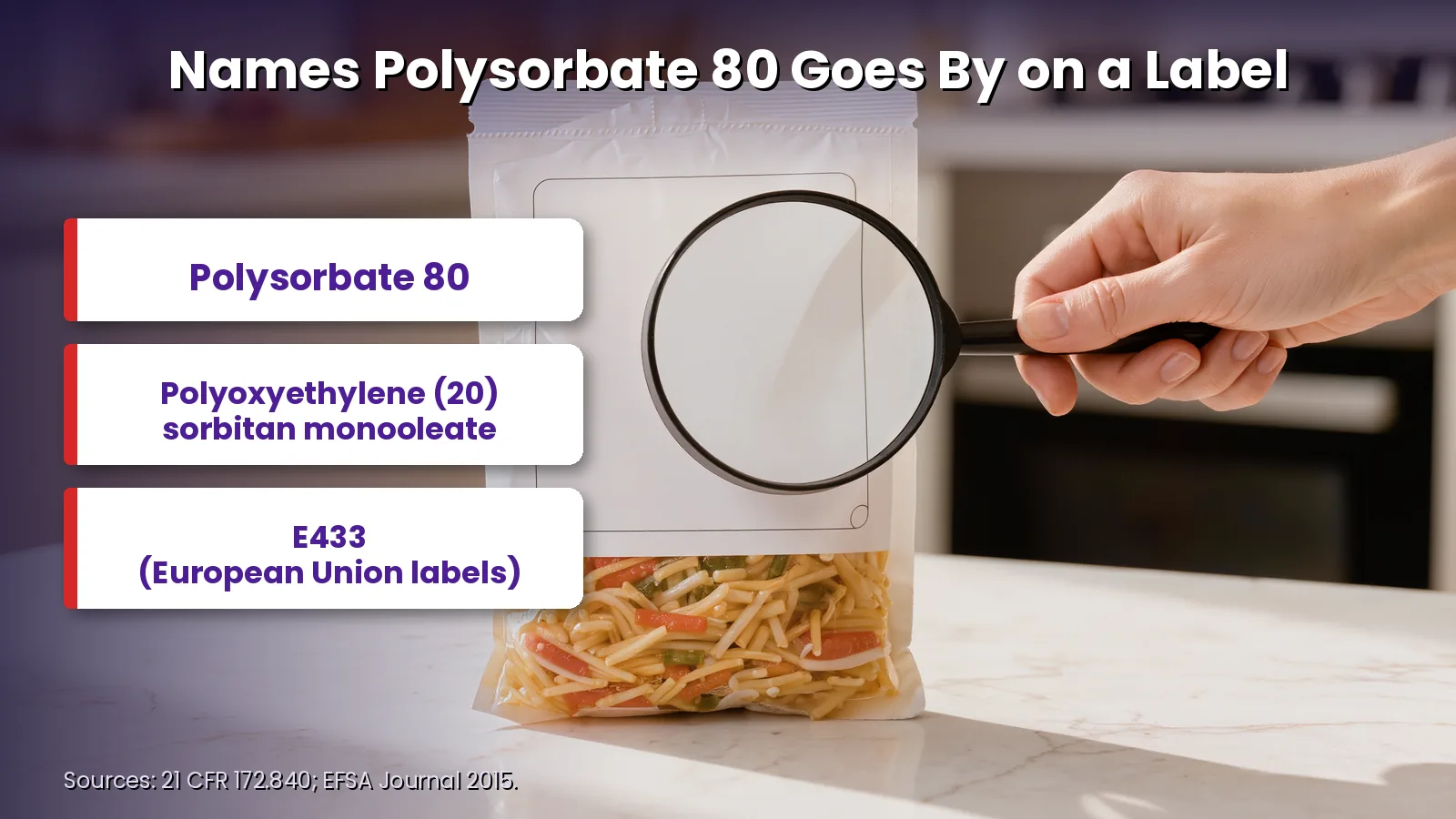
On a US label, the ingredient list will usually say exactly what you expect: polysorbate 80. Some manufacturers spell out the chemical name instead, polyoxyethylene (20) sorbitan monooleate, which is the same substance [1]. On products from the European Union, look for E 433 [2].
Where to look: read the whole ingredient list, not just the first few lines. Because the FDA limits are so low, polysorbate 80 is used in small amounts, so do not stop reading early.
The foods worth checking are the ones from the table above. Frozen desserts, pickles, whipped toppings, gelatin mixes and barbecue sauces are the places you are most likely to find it. If it appears on a food that is not on FDA's list, that is worth a second look at the label and the country of origin.
One more thing to know: a label can say "emulsifier" in the description on the front and still list the specific emulsifier on the back. The front of the package is marketing. The ingredient list is the record. The same goes for terms like "natural flavors," which cover more than most people assume, as we explained in our natural flavors investigation.
Is Polysorbate 80 Safe? Where FDA, EFSA and JECFA Stand in 2026
Three bodies have put polysorbate 80 on the record: FDA, the European Food Safety Authority (EFSA) and the Joint FAO/WHO Expert Committee on Food Additives (JECFA). We read what each one actually concluded.
FDA
FDA's position is the rule itself. Polysorbate 80 may be used in the foods listed in 21 CFR 172.840, at the limits in that rule [1]. The food-by-food caps are the control.
JECFA, 1973 and 2026
JECFA is the WHO and FAO committee that sets international safety benchmarks. Its tool is the acceptable daily intake, or ADI, expressed in milligrams per kilogram of body weight per day.
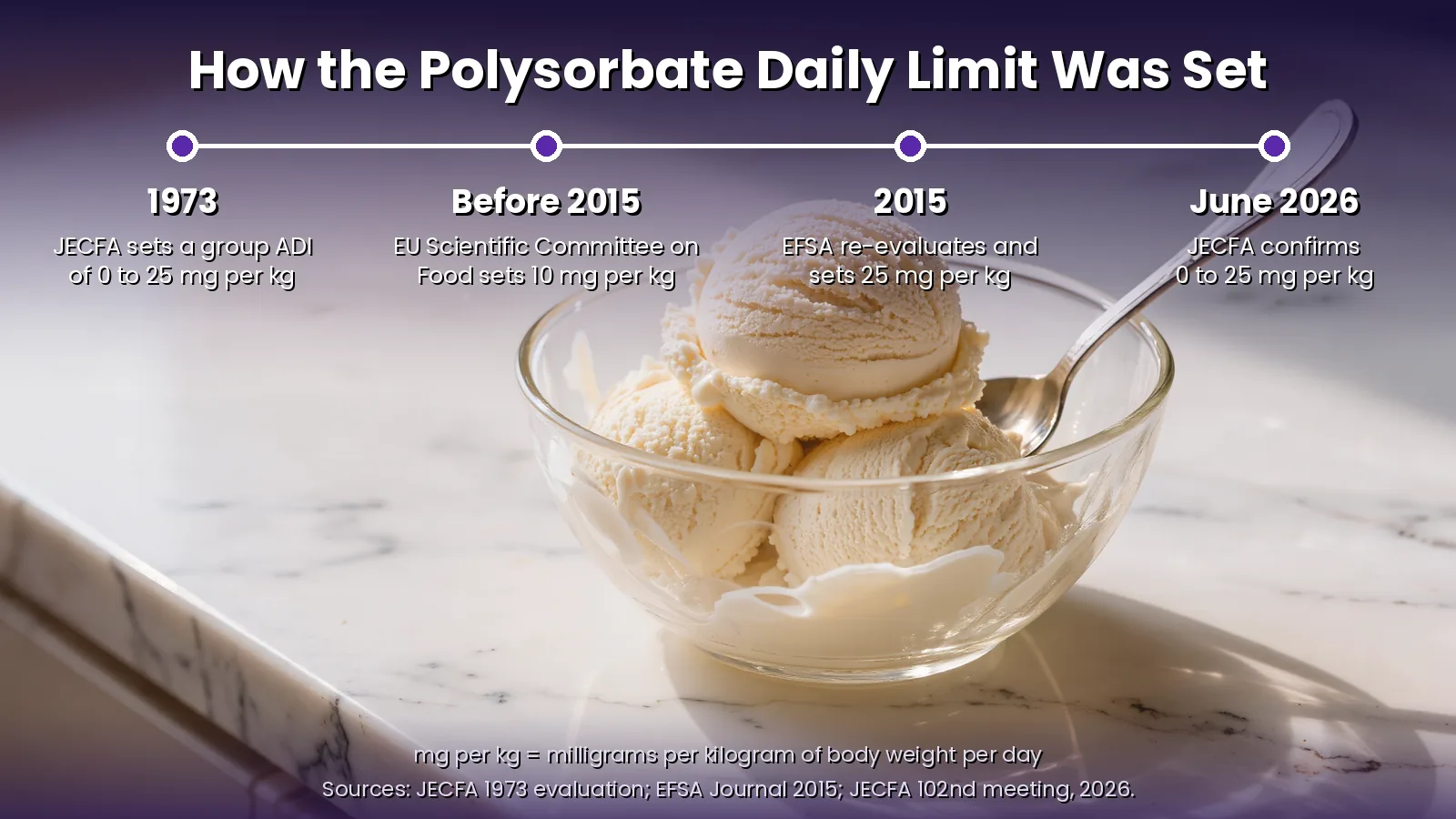
JECFA first set an ADI for the polysorbates at its 17th meeting in 1973: 0 to 25 mg per kg of body weight, counted as the total of all polyoxyethylene (20) sorbitan esters [3].
At its 102nd meeting, held June 9 to 18, 2026, the committee looked again. It confirmed the group ADI of 0 to 25 mg per kg of body weight, based on a no-observed-adverse-effect level of 2,500 mg per kg per day in two long-term rat studies [4]. The highest estimated intake it found was 24.5 mg per kg of body weight per day, for children aged 1 to 17 in Europe, and it concluded that current uses do not pose a safety concern [4].
One detail from the 2026 meeting did not make the headlines. JECFA said more information is needed to complete the polysorbate specifications, and asked for manufacturing details and data on ethylene oxide, ethylene glycols, 1,4-dioxane and toxic elements (arsenic, lead, mercury, cadmium) [4]. That is a request about purity standards for the manufactured ingredient, not a finding about the additive in food, but it is part of the record.
EFSA, 2015
Before EFSA's re-evaluation, the EU Scientific Committee on Food had set a lower group ADI of 10 mg per kg of body weight per day [2].
In 2015, EFSA re-evaluated polysorbates 20, 80, 40, 60 and 65 (E 432 to E 436) and set a group ADI of 25 mg per kg of body weight per day [2]. It based that figure on a no-observed-adverse-effect level of 2,500 mg per kg of body weight per day from a long-term rat carcinogenicity study, applying an uncertainty factor of 100 [2]. EFSA found that only small amounts of polysorbates are absorbed, and reported no concern for genotoxicity, carcinogenicity or developmental toxicity [2].
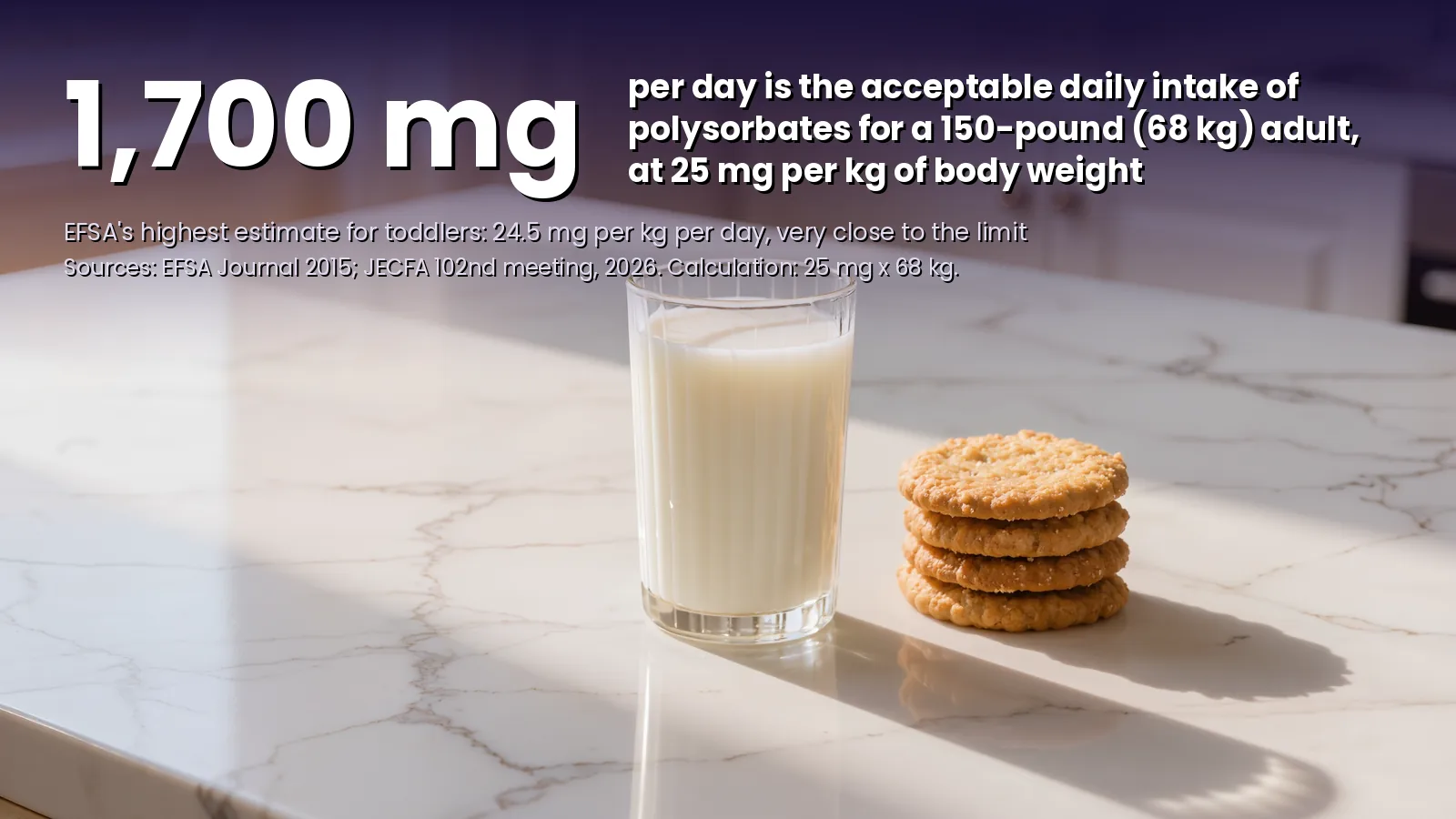
EFSA also flagged a gap. It estimated that toddlers' highest exposure, in the scenario where a child is not loyal to any one brand, was 24.5 mg per kg of body weight per day, very close to the ADI, and said more usage and analytical data were needed [2].
What the ADI means in real numbers
An ADI of 25 mg per kg of body weight works out to 1,700 mg per day for a 150-pound (68 kg) adult [5]. For a toddler, the same per-kilogram limit is a much smaller number of milligrams, which is why EFSA's toddler estimate came so close to the line.
The pattern across all three regulators is consistent: the additive is poorly absorbed, long-term animal studies set a high no-effect level, and the daily limit sits 100 times below that. The open question regulators themselves raised is not whether the limit is right, but whether the youngest eaters are brushing up against it.
What the Research Says: Mouse and Lab Studies
The studies that get cited most when polysorbate 80 comes up are a small set. We read each of them. All of the ones in this section were done in mice or in laboratory models of the gut, not in people, and that distinction is the whole story.
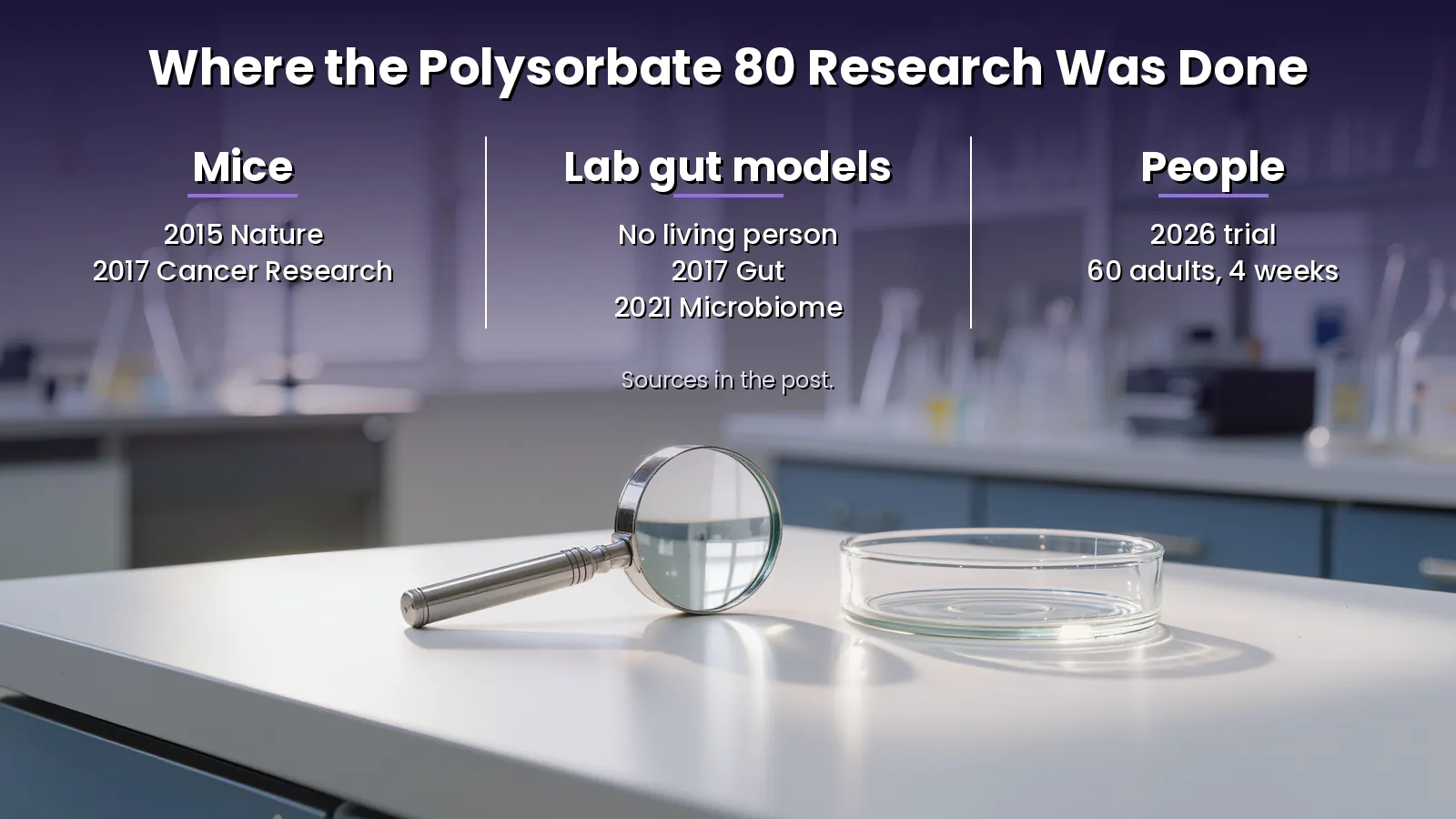
A 2015 study in Nature found that in mice, relatively low concentrations of polysorbate 80 and carboxymethylcellulose caused low-grade inflammation and obesity and metabolic syndrome in normal mice, and strong colitis in mice prone to it [6]. In that study, experiments with germ-free mice and fecal transplants indicated that the changes in gut bacteria were necessary and sufficient to cause the low-grade inflammation and metabolic syndrome [6]. In plain terms: when the researchers moved the altered gut bacteria into mice that had never eaten the emulsifiers, the effects moved with them.
A 2017 mouse study in Cancer Research gave mice polysorbate 80 or carboxymethylcellulose at 1.0% in drinking water and found that regular consumption worsened tumor development in a model of colitis-associated colon cancer [7].
A 2017 study in Gut took the live animal out of the picture. It used a laboratory model of the human gut microbiota (called M-SHIME), with no live host, and found polysorbate 80 directly raised the bacteria's pro-inflammatory potential, measured as more bioactive flagellin. The change happened more slowly than with carboxymethylcellulose and was linked to shifts in which bacterial species were present [8].
A 2021 study in Microbiome widened the lens. It tested 20 common dietary emulsifiers on human gut bacteria in a lab model and found polysorbate 80 and carboxymethylcellulose had a lasting, seemingly harmful effect on microbiota composition and function, while lecithin did not significantly affect the microbiota in that model [9].
What these studies show, taken together, is a consistent signal in mice and in bacteria grown in the lab: polysorbate 80 can change the gut community and nudge it toward a more inflammatory state. What they do not show is that the same thing happens in a person eating ice cream capped at 0.1 percent polysorbate 80. Mice in the Cancer Research study drank it at 1.0 percent in their water, every day. Dose, species and delivery all differ from a human diet. The research is a reason to ask the question, not an answer to it.
That is the same gap we found when we looked at the research on food additives and ADHD: strong findings in animals and cells, and a much thinner record in people.
What the Research Says: The Human Trial
A placebo-controlled randomized trial in people was published in 2026.
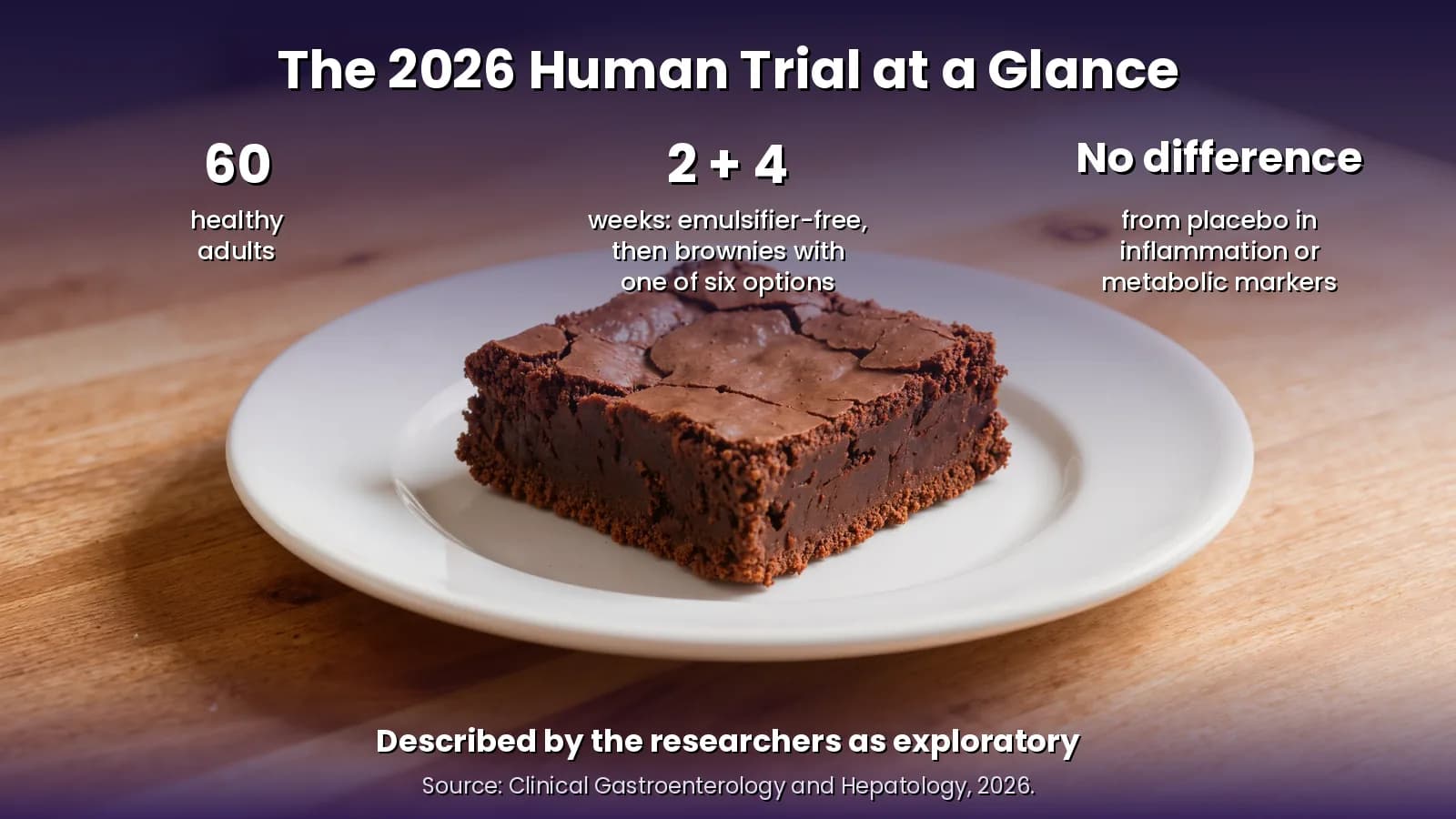
The trial had 60 healthy adults eat an emulsifier-free diet for 2 weeks, then continue it for 4 weeks while eating brownies containing one of six things: carboxymethylcellulose, polysorbate 80, carrageenan, soy lecithin, native rice starch, or no additive [10]. Sixty people spread across six groups works out to about ten per group, which is small.
Three findings matter here.
First, cholesterol levels fell after the 2-week emulsifier-free diet, before any brownies were added [10]. The trial was not designed to explain why, and cutting emulsifiers from a diet changes many other things about what a person eats.
Second, all short-chain fatty acids were lower with carboxymethylcellulose than with placebo, and other emulsifiers showed a similar pattern, though not all differences were statistically significant [10]. This is the human-side echo of the mouse studies, faint but present.
Third, and most important for the question in this article: the researchers found no differences between placebo and emulsifiers in fecal calprotectin, C-reactive protein, serum lipopolysaccharide-binding protein, cholesterol or other metabolic markers at the end, and described the study as exploratory [10]. Four weeks of polysorbate 80 brownies did not move those markers.
That is where the human evidence stands in October 2026: a small, short, exploratory trial that found a hint of change in short-chain fatty acids and no change in inflammation markers. It neither confirms the mouse findings nor rules them out. Anyone telling you the human research is settled, in either direction, has not read it.
Check the Carton You Buy
Here is what you can do with all of this today.
Turn the package over and read the full ingredient list. Look for "polysorbate 80," "polyoxyethylene (20) sorbitan monooleate" or, on imports, "E433" [1, 2].
Know which foods to check. Ice cream and frozen desserts, pickles, whipped toppings, gelatin desserts, shortenings, cottage cheese, barbecue sauce and some vitamin supplements are the places FDA permits it [1].
Keep the dose in view. A 150-pound adult would need 1,700 mg a day to reach the ADI [5]. At 0.1 percent of a frozen dessert, that is a very large amount of ice cream. The regulators' own concern is toddlers, whose smaller bodies bring the per-kilogram limit much closer [2].
Think of it as a marker. Polysorbate 80 shows up in foods built to hold a texture for a long time on a shelf. If a label lists it, the food is usually one that fits the definition of ultra-processed, and that is a more useful thing to know than any single ingredient.
If you would rather not read every label by hand, the NutraDetective app scans the ingredient list for you and flags polysorbate 80 along with the other additives we track.
And if you have a digestive condition and are wondering whether emulsifiers matter for you, that is a question for your doctor or a registered dietitian. The research is not far enough along for anyone else to answer it.
Frequently Asked Questions
A. Polysorbate 80 is made by reacting oleic acid, a fatty acid, with sorbitol, a sugar alcohol, and then reacting that product with ethylene oxide. The full chemical name is polyoxyethylene (20) sorbitan monooleate. FDA describes the process in 21 CFR 172.840.
A. Not in the United States or the European Union. FDA permits it in specific foods at set limits, and the EU lists it as E 433 with a group acceptable daily intake of 25 mg per kg of body weight. The WHO's expert committee confirmed the same group limit in June 2026.
A. By FDA's limits, shortenings and edible oils carry the highest cap at 1 percent, followed by whipped edible oil toppings at 0.4 percent and ice cream and other frozen desserts at 0.1 percent. Vitamin-mineral preparations have their own limits of 175 mg, 300 mg or 475 mg per recommended daily dose, depending on the formula.
A. In mice, a 2015 study found it caused low-grade inflammation and metabolic changes, and later lab studies found it changed human gut bacteria in a dish. In a controlled trial in people published in 2026, four weeks of polysorbate 80 produced no difference in inflammation markers compared with placebo. The human evidence is still thin and the researchers called their trial exploratory.
A. EFSA and JECFA both set a group acceptable daily intake of 25 mg per kg of body weight per day for the polysorbates. For a 150-pound (68 kg) adult, that is 1,700 mg per day. The figure is based on a no-effect level of 2,500 mg per kg per day in long-term rat studies, divided by an uncertainty factor of 100.
A. Yes. E 433 is the European Union's code for polysorbate 80. On a US label it usually appears as "polysorbate 80" or occasionally as its chemical name, polyoxyethylene (20) sorbitan monooleate.
A. Regulators have not told parents to avoid it, but EFSA's 2015 re-evaluation estimated that toddlers with the highest intake could reach 24.5 mg per kg per day, very close to the 25 mg per kg limit, and JECFA's 2026 estimate put the highest exposure at 24.5 mg per kg per day for children aged 1 to 17 in Europe. Both bodies asked for more data. If you have concerns about your child's diet, talk with your pediatrician.
References
- U.S. Food and Drug Administration. 21 CFR 172.840, Polysorbate 80. Code of Federal Regulations, current edition. https://www.ecfr.gov/current/title-21/chapter-I/subchapter-B/part-172/subpart-I/section-172.840
- EFSA Panel on Food Additives and Nutrient Sources added to Food (ANS). Scientific Opinion on the re-evaluation of polyoxyethylene sorbitan monolaurate (E 432), polyoxyethylene sorbitan monooleate (E 433), polyoxyethylene sorbitan monopalmitate (E 434), polyoxyethylene sorbitan monostearate (E 435) and polyoxyethylene sorbitan tristearate (E 436) as food additives. EFSA Journal 2015;13(7):4152. https://doi.org/10.2903/j.efsa.2015.4152
- World Health Organization, International Programme on Chemical Safety (INCHEM). JECFA evaluation: Polyoxyethylene (20) sorbitan monooleate (Polysorbate 80), INS 433. Evaluated 1973, 17th meeting. https://inchem.org/documents/jecfa/jeceval/jec_1951.htm
- Joint FAO/WHO Expert Committee on Food Additives (JECFA). Summary and Conclusions of the 102nd Meeting, Nanjing, 9 to 18 June 2026. Issued July 7, 2026. https://cdn.who.int/media/docs/default-source/food-safety/jecfa/summary-and-conclusions/jecfa-102-summary-report_final.pdf
- NutraDetective calculation: 25 mg per kg x 68 kg = 1,700 mg per day.
- Chassaing B, Koren O, Goodrich JK, et al. Dietary emulsifiers impact the mouse gut microbiota promoting colitis and metabolic syndrome. Nature. 2015;519(7541):92-96. https://pubmed.ncbi.nlm.nih.gov/25731162/ (full text: https://pmc.ncbi.nlm.nih.gov/articles/PMC4910713/)
- Viennois E, Merlin D, Gewirtz AT, Chassaing B. Dietary emulsifier-induced low-grade inflammation promotes colon carcinogenesis. Cancer Research. 2017;77(1):27-40. https://pubmed.ncbi.nlm.nih.gov/27821485/
- Chassaing B, Van de Wiele T, De Bodt J, Marzorati M, Gewirtz AT. Dietary emulsifiers directly alter human microbiota composition and gene expression ex vivo potentiating intestinal inflammation. Gut. 2017;66(8):1414-1427. https://pubmed.ncbi.nlm.nih.gov/28325746/
- Naimi S, Viennois E, Gewirtz AT, Chassaing B. Direct impact of commonly used dietary emulsifiers on human gut microbiota. Microbiome. 2021;9(1):66. https://pubmed.ncbi.nlm.nih.gov/33752754/
- Wellens J, Vanderstappen J, Hoekx S, et al. Effect of Five Dietary Emulsifiers on Inflammation, Permeability, and the Gut Microbiome: A Placebo-controlled Randomized Trial. Clinical Gastroenterology and Hepatology. 2026;24(4):1092-1101. https://pubmed.ncbi.nlm.nih.gov/40816342/
- U.S. Food and Drug Administration. 21 CFR 101.4, Food; designation of ingredients. Code of Federal Regulations, current edition. https://www.ecfr.gov/current/title-21/chapter-I/subchapter-B/part-101/section-101.4
- ClinicalTrials.gov. FOod Additives on the Mucosal Barrier (FOAM), NCT06552156. Universitaire Ziekenhuizen KU Leuven. https://clinicaltrials.gov/study/NCT06552156